Fully Abstract Models of the Lambda Calculus
This post describes the denotational semantics of the lambda calculus.


This post discusses the denotational semantics of the lambda calculus.
Models
Definition (Partial Equivalence Relation - PER). A partial equivalence relation (PER) is a symmetric, transitive relation \(R \subseteq D \times D\) on a set \(D\).
Definition (PER Domain). The domain of a partial equivalence relation \(R\) on a set \(D\) is the set
\[\mathrm{dom}(R) = \{d \in D \mid d \mathrel{R} d\}.\]
Definition (Environment). Given a partial equivalence relation \(R \subseteq D \times D\) on a set \(D\) called a semantic domain, an environment is a map \(\rho : \mathcal{V} \rightarrow \mathrm{dom}(R)\). The set of all environments for a given relation is denoted \(\mathrm{Env}(R)\).
Definition (Environmental Update). Given a partial equivalence relation \(R \subseteq D \times D\) on a semantic domain \(D\) and an environment \(\rho \in \mathrm{Env}(R)\), the environmental update of \(\rho\) with the variable \(x \in \mathcal{V}\) updated to \(d \in \mathrm{dom}(R)\) is defined as
\[\rho[x \mapsto d](x') = \begin{cases} d &\text{if } x = x' \\ \rho(x') & \text{otherwise}.\end{cases}\]
Definition (Model). A model \(\mathcal{M} = (D, R, \cdot, \llbracket \cdot \rrbracket_{(\cdot)})\) consists of the following items:
- A set \(D\) called the carrier or semantic domain;
- A partial equivalence relation \(R \subseteq D \times D\);
- A distinguished element \(\bot \in \mathrm{dom}(R)\) representing divergence;
- A binary operation \(\cdot : D \times D \rightarrow D\) called application;
- A map \(\llbracket \cdot \rrbracket_{(\cdot)} : \Lambda \times \mathrm{Env}(R) \rightarrow \mathrm{dom}(R)\), where \(\llbracket M \rrbracket_{\rho}\) is called the denotation of the term \(M \in \Lambda\) under the environment \(\rho \in \mathrm{Env}(R)\);
these items are subject to the following axioms:
- Congruence: for all \(f,g,x,y \in D\), if \(f \mathrel{R} g\) and \(x \mathrel{R} y\) then \((f \cdot x) \mathrel{R} (g \cdot y)\);
- Variable Assignment: \(\llbracket x \rrbracket_{\rho} = \rho(x)\) for all variables \(x \in \mathcal{V}\) and environments \(\rho \in \mathrm{Env}(R)\);
- Semantic Abstraction: \(\left(\llbracket (\lambda x . M) \rrbracket_{\rho} \cdot d\right) \mathrel{R} \llbracket M \rrbracket_{\rho[x \mapsto d]}\) for all variables \(x \in \mathcal{V}\), terms \(M \in \Lambda\), environments \(\rho \in \mathrm{Env}(R)\), and elements \(d \in \mathrm{dom}(R)\);
- Applicative Consistency: \(\llbracket (MN) \rrbracket_{\rho} \mathrel{R} \left(\llbracket M \rrbracket_{\rho} \cdot \llbracket N \rrbracket_{\rho}\right)\) for all terms \(M,N \in \Lambda\) and environments \(\rho \in \mathrm{Env}(R)\);
- Environmental Consistency: for all terms \(M \in \Lambda\) and environments \(\rho, \rho' \in \mathrm{Env}(R)\), if \(\rho(x) \mathrel{R} \rho'(x)\) for all \(x \in \mathrm{Free}(M)\), then \(\llbracket M \rrbracket_{\rho} \mathrel{R} \llbracket M \rrbracket_{\rho'}\);
- Extensionality: for all \(f,g \in \mathrm{dom}(R)\), if \((f \cdot x) \mathrel{R} (g \cdot y)\) for all \(x,y \in \mathrm{dom}(R)\) such that \(x \mathrel{R} y\), then \(f \mathrel{R} g\).
Definition (Satisfaction). For a model \(\mathcal{M} = (D, R, \cdot, \llbracket \cdot \rrbracket_{(\cdot)})\), environment \(\rho \in \mathrm{Env}(R)\), and terms \(M,N \in \Lambda\) we make the following definitions:
- \(\mathcal{M},\rho \models M = N\) if and only if \(\llbracket M \rrbracket_{\rho} \mathrel{R} \llbracket N \rrbracket_{\rho}\). If \(M\) and \(N\) are closed terms (\(M, N \in \Lambda(\emptyset)\)), we write \(\mathcal{M} \models M = N\) to indicate that \(\mathcal{M},\rho \models M = N\) for every environment \(\rho \in \mathrm{Env}(R)\).
- \(\mathcal{M},\rho \models M \downarrow\) if and only if \(\llbracket M \rrbracket_{\rho} \ne \bot\). If \(M\) is a closed term (\(M \in \Lambda(\emptyset)\)), we write \(\mathcal{M} \models M \downarrow\) to indicate that \(\mathcal{M},\rho \models M \downarrow\) for every environment \(\rho \in \mathrm{Env}(R)\).
Definition (Adequacy). A model is adequate with respect to an evaluation strategy \(\mathrm{s}\) if, for every closed term \(M \in \Lambda(\emptyset)\),
\[\mathcal{M} \models M \downarrow \Leftrightarrow M \Downarrow_{\mathrm{s}}.\]
Definition (Soundness). A model is sound with respect to an evaluation strategy \(\mathrm{s}\) if, for all closed terms \(M, N \in \Lambda(\emptyset)\),
\[\mathcal{M} \models M = N \Rightarrow M \approx_{\mathrm{s}} N.\]
Definition (Completeness). A model is complete with respect to an evaluation strategy \(\mathrm{s}\) if, for all closed terms \(M, N \in \Lambda(\emptyset)\),
\[M \approx_{\mathrm{s}} N \Rightarrow \mathcal{M} \models M = N.\]
Definition (Full Abstraction). A model is fully abstract with respect to an evaluation strategy if it is both sound and complete with respect to this evaluation strategy, i.e., if, for all closed terms \(M, N \in \Lambda(\emptyset)\),
\[\mathcal{M} \models M = N \Leftrightarrow M \approx_{\mathrm{s}} N.\]
Complete Partial Orders
This section introduces complete partial orders.
Definition (\(\mathbf{\omega}\)-chain). An \(\mathbf{\omega}\)-chain in a partial order \((D, \sqsubseteq)\) is a sequence \((d_n)_{n \in \mathbb{N}}\) such that \(d_n \sqsubseteq d_{n+1}\) for all \(n \in \mathbb{N}\).
Notation (\(\mathbf{\omega}\)-chain Supremum). The supremum (least upper bound) of an \(\omega\)-chain \((d_n)_{n \in \mathbb{N}}\) in a partial order \((D, \sqsubseteq)\) is denoted
\[\bigsqcup_{n \in \mathbb{N}}d_n.\]
Definition (\(\mathbf{\omega}\)-Complete Partial Order). A partial order \((D, \sqsubseteq)\) is \(\mathbf{\omega}\)-complete if it contains all suprema of \(\omega\)-chains.
Definition (Pointed Partial Order). A partial order \((D, \sqsubseteq)\) is pointed if it contains a least element \(\bot \in D\).
Terminological Note: henceforth, we will simply write "complete partial order" or "CPO" to indicate a pointed, \(\omega\)-complete partial order.
Definition (Admissible PER). A partial equivalence relation \(R\) is admissible for a CPO \((D, \sqsubseteq)\) if
\[\left(\bigsqcup_{n \in \mathbb{N}}x_n\right) \mathrel{R} \left(\bigsqcup_{n \in \mathbb{N}}y_n\right)\]
for every pair of \(\omega\)-chains \((x_n)_{n \in \mathbb{N}}\) and \((y_n)_{n \in \mathbb{N}}\) in \(D\) such that \(x_n \mathrel{R} y_n\) for all \(n \in \mathbb{N}\).
Definition (Continuous Map). A map \(F : D \rightarrow E\) between a CPO \((D, \sqsubseteq_D)\) and a CPO \((E, \sqsubseteq_E)\) is continuous if, for every \(\omega\)-chain \((d_n)_{n \in \mathbb{N}}\) in \(D\) the sequence \((F(d_n))_{n \in \mathbb{N}}\) is an \(\omega\)-chain and
\[F\left(\bigsqcup_{n \in \mathbb{N}}d_n\right) = \bigsqcup_{n \in \mathbb{N}}F(d_n).\]
Theorem (Monotonicity of Continuous Maps). Every continuous map between CPOs is monotone.
Proof. Let \(F : D \rightarrow E\) be any continuous map between CPOs \((D, \sqsubseteq_D)\) and \((E, \sqsubseteq_E)\). Suppose that \(x \sqsubseteq_D y\) for any \(x,y \in D\). Define an \(\omega\)-chain \((d_n)_{n \in \mathbb{N}}\) as follows: \(d_0 = x\), \(d_n = y\) for all \(n \ge 1\). Then:
\begin{align*}F(x) &= F(d_0) \\& \sqsubseteq_E \bigsqcup_{n \in \mathbb{N}}F(d_n) \\&= F\left(\bigsqcup_{n \in \mathbb{N}}d_n\right) \\&= F(y).\end{align*}
Theorem (Least Fixed Point). For any CPO \((D, \sqsubseteq)\) and continuous map \(F : D \rightarrow D\), the least fixed point of \(F\) is given by
\[\mu F = \bigsqcup_{n \in \mathbb{N}}F^n(\bot).\]
Proof. First note that \(\bot \sqsubseteq F^0(\bot) = \bot\) and, if \(F^n(\bot) \sqsubseteq F^{n+1}(\bot)\) then, since \(F\) is continuous, it is also monotone, and so \(F^{n+1}(\bot) = F(F^n(\bot)) \sqsubseteq F(F^{n+1}(\bot)) = F^{n+2}(\bot)\). Thus, by induction, it follows that \((F^n(\bot))_{n \in \mathbb{N}}\) is an \(\omega\)-chain and therefore \(\bigsqcup_{n \in \mathbb{N}}F^n(\bot) \in D\) and \(\mu F\) is well-defined. Next, note that
\begin{align*}F\left(\bigsqcup_{n \in \mathbb{N}}F^n(\bot)\right) &= \bigsqcup_{n \in \mathbb{N}}F(F^n(\bot)) \\&= \bigsqcup_{n \in \mathbb{N}}F^{n+1}(\bot) \\&= \bigsqcup_{n \in \mathbb{N}}F^n(\bot).\end{align*}
Finally, if \(F(p) = p\) (and hence \(F(p) \sqsubseteq p\) by reflexivity) for some \(p \in D\), then \(F^0(\bot) = \bot \sqsubseteq p\), and, if \(F^n(\bot) \sqsubseteq p\), then, by monotonicity, \(F^{n+1}(p) = F(F^n(\bot)) \sqsubseteq F(p) \sqsubseteq p\). Thus, by induction, \(F^n(\bot) \sqsubseteq p\) for all \(n \in \mathbb{N}\) and \(p\) is an upper bound of the \(\omega\)-chain \((F^n(\bot))_{n \in \mathbb{N}}\) and therefore, by definition, \(\bigsqcup_{n \in \mathbb{N}}F^n(\bot) \sqsubseteq p\). \(\square\)
Theorem (Interchange of Suprema). For any family of elements \(d_{m,n}\) for \(m,n \in \mathbb{N}\) in a CPO \((D, \sqsubseteq)\), if \((d_{m,n})_{n \in \mathbb{N}}\) is an \(\omega\)-chain for each \(m \in \mathbb{N}\) and \((d_{m,n})_{m \in \mathbb{N}}\) is an \(\omega\)-chain for each \(n \in \mathbb{N}\), then
\[\bigsqcup_{m \in \mathbb{N}}\bigsqcup_{n \in \mathbb{N}}d_{m,n} = \bigsqcup_{n \in \mathbb{N}}\bigsqcup_{m \in \mathbb{N}}d_{m,n}.\]
Proof. First, we verify that \(\left(\bigsqcup_{n \in \mathbb{N}}d_{m,n}\right)_{m \in \mathbb{N}}\) is an \(\omega\)-chain. By hypothesis, \(d_{m,n} \sqsubseteq d_{m+1,n}\) for all \(n \in \mathbb{N}\) and since \(d_{m+1,n} \sqsubseteq \bigsqcup_{n \in \mathbb{N}}d_{m+1,n}\) by definition, it follows that \(d_{m,n} \sqsubseteq \bigsqcup_{n \in \mathbb{N}}d_{m+1,n}\). Since \(n\) was arbitrary, \(\bigsqcup_{n \in \mathbb{N}}d_{m+1,n}\) is an upper bound of the \(\omega\)-chain \((d_{m,n})_{n \in \mathbb{N}}\) and thus \(\bigsqcup_{n \in \mathbb{N}}d_{m,n} \sqsubseteq \bigsqcup_{n \in \mathbb{N}}d_{m+1,n}\).
A symmetric argument shows that \(\left(\bigsqcup_{m \in \mathbb{N}}d_{m,n}\right)_{n \in \mathbb{N}}\) is an \(\omega\)-chain.
Let \(m,n \in \mathbb{N}\) be arbitrary. Then
\[d_{m,n} \sqsubseteq \bigsqcup_{m \in \mathbb{N}}d_{m,n} \sqsubseteq \bigsqcup_{n \in \mathbb{N}}\bigsqcup_{m \in \mathbb{N}}d_{m,n}.\]
It follows that
\[\bigsqcup_{n \in \mathbb{N}}d_{m,n} \sqsubseteq \bigsqcup_{n \in \mathbb{N}}\bigsqcup_{m \in \mathbb{N}}d_{m,n}\]
and also that
\[\bigsqcup_{m \in \mathbb{N}}\bigsqcup_{n \in \mathbb{N}}d_{m,n} \sqsubseteq \bigsqcup_{n \in \mathbb{N}}\bigsqcup_{m \in \mathbb{N}}d_{m,n}.\]
A symmetric argument shows that
\[\bigsqcup_{n \in \mathbb{N}}\bigsqcup_{m \in \mathbb{N}}d_{m,n} \sqsubseteq \bigsqcup_{m \in \mathbb{N}}\bigsqcup_{n \in \mathbb{N}}d_{m,n}.\]
\(\square\)
Theorem (Diagonalization of Suprema). For any CPO \((D, \sqsubseteq)\) and family of elements \((d_{m,n})_{m,n \in \mathbb{N}}\) in \(D\) that are jointly monotonic, i.e., \(d_{m,n} \sqsubseteq d_{m',n'}\) whenever \(m \le m'\) and \(n \le n'\), then
\[\bigsqcup_{m \in \mathbb{N}}\bigsqcup_{n \in \mathbb{N}}d_{m,n} = \bigsqcup_{k \in \mathbb{N}} d_{k,k}.\]
Proof. Note that for any \(k \in \mathbb{N}\),
\[d_{k,k} \sqsubseteq \bigsqcup_{n \in \mathbb{N}} d_{k,n} \sqsubseteq \bigsqcup_{m \in \mathbb{N}}\bigsqcup_{n \in \mathbb{N}} d_{m,n}.\]
This means that \(\bigsqcup_{m \in \mathbb{N}}\bigsqcup_{n \in \mathbb{N}}d_{m,n}\) is an upper bound of the \(\omega\)-chain \((d_{k,k})_{k \in \mathbb{N}}\) and thus
\[\bigsqcup_{k \in \mathbb{N}} d_{k,k} \sqsubseteq \bigsqcup_{m \in \mathbb{N}}\bigsqcup_{n \in \mathbb{N}}d_{m,n}.\]
Conversely, for any \(m,n \in \mathbb{N}\), if \(p = \mathrm{max}(m,n)\), then \(d_{m,n} \sqsubseteq d_{p,p}\) and thus
\[d_{m,n} \sqsubseteq d_{p,p} \sqsubseteq \bigsqcup_{k \in \mathbb{N}}d_{k,k}\]
and thus \(\bigsqcup_{k \in \mathbb{N}}d_{k,k}\) is an upper bound of the \(\omega\)-chain \((d_{m,n})_{n \in \mathbb{N}}\) and so
\[\bigsqcup_{n \in \mathbb{N}}d_{m,n} \sqsubseteq \bigsqcup_{k \in \mathbb{N}}d_{k,k}\]
and hence \(\bigsqcup_{k \in \mathbb{N}}d_{k,k}\) is an upper bound of the \(\omega\)-chain \((\bigsqcup_{n \in \mathbb{N}}d_{m,n})_{m \in \mathbb{N}}\) and thus
\[\bigsqcup_{m \in \mathbb{N}}\bigsqcup_{n \in \mathbb{N}}d_{m,n} \sqsubseteq \bigsqcup_{k \in \mathbb{N}} d_{k,k}.\]
\(\square\)
Theorem (Function Space). For any CPOs \((D, \sqsubseteq_D)\) and \((E, \sqsubseteq_E)\), the set of all continuous maps \(\mathrm{Cont}(D, E)\) is a CPO under the following ordering for any \(F, G \in \mathrm{Cont}(D, E)\):
\[F \sqsubseteq G \Leftrightarrow \forall d \in D(F(d) \sqsubseteq_E G(d)).\]
Proof. For any map \(F \in \mathrm{Cont}(D, E)\) and every \(d \in D\), \(F(d) \sqsubseteq_E F(d)\) by reflexivity and thus \(F \sqsubseteq F\), so the order is reflexive.
For any maps \(F, G \in \mathrm{Cont}(D, E)\), if \(F \sqsubseteq G\) and \(G \sqsubseteq F\), then, for any \(d \in D\), \(F(d) \sqsubseteq_E G(d)\) and \(G(d) \sqsubseteq_E F(d)\), so, by antisymmetry, \(F(d) = G(d)\). Since \(d\) was arbitrary, \(F = G\) and the order is thus antisymmetric.
For any maps \(F,G,H \in \mathrm{Cont}(D,E)\), if \(F \sqsubseteq G\) and \(G \sqsubseteq H\), then, for any \(d \in D\), \(F(d) \sqsubseteq_E G(d)\) and \(G(d) \sqsubseteq_E H(d)\), so, by transitivity, \(F(d) \sqsubseteq_E H(d)\). Since \(d\) was arbitrary, \(F \sqsubseteq H\) and the order is thus transitive.
Since the order is reflexive, antisymmetric, and transitive, it is a partial order and is thus well-defined.
We define
\[\bot = d \mapsto \bot\]
so that, for any map \(F \in \mathrm{Cont}(D, E)\) and any \(d \in D\), \(\bot(d) = \bot \sqsubseteq_E F(d)\) and hence \(\bot \sqsubseteq F\). Note also that \(\bot\) is continuous: for any \(\omega\)-chain \((d_n)_{n \in \mathbb{N}}\) in \(D\),
\[\bot\left(\bigsqcup_{n \in \mathbb{N}}d_n\right) = \bot = \bigsqcup_{n \in \mathbb{N}}\bot(d_n).\]
We claim that, for any \(\omega\)-chain \((F_n)_{n \in \mathbb{N}}\) in \(\mathrm{Cont}(D, E)\),
\[\left(\bigsqcup_{n \in \mathbb{N}}F_n\right)(x) = \bigsqcup_{n \in \mathbb{N}}F_n(x).\]
We will show that \(\bigsqcup_{n \in \mathbb{N}}F_n\) is continuous. Let \((d_m)_{m \in \mathbb{N}}\) be any \(\omega\)-chain in \(D\). Observe that
\begin{align*}\left(\bigsqcup_{n \in \mathbb{N}}F_n\right)\left(\bigsqcup_{m \in \mathbb{N}}d_m\right) &= \bigsqcup_{n \in \mathbb{N}}F_n\left(\bigsqcup_{m \in \mathbb{N}}d_m\right) \\&= \bigsqcup_{n \in \mathbb{N}}\left(\bigsqcup_{m \in \mathbb{N}}F_n(d_m)\right) \\&= \bigsqcup_{m \in \mathbb{N}}\left(\bigsqcup_{n \in \mathbb{N}}F_n(d_m)\right) \\&= \bigsqcup_{m \in \mathbb{N}}\left(\left(\bigsqcup_{n \in \mathbb{N}}F_n\right)(d_m)\right). \end{align*}
For any \(d \in D\) and \(n \in \mathbb{N}\), \(F_n(d) \sqsubseteq \bigsqcup_{n \in \mathbb{N}}F_n(d)\) and thus \(F_n \sqsubseteq \bigsqcup_{n \in \mathbb{N}}F_n\) and \(\bigsqcup_{n \in \mathbb{N}}F_n\) is an upper bound of the \(\omega\)-chain \((F_n)_{n \in \mathbb{N}}\).
If \(U \in \mathrm{Cont}(D, E)\) is any other upper bound of \((F_n)_{n \in \mathbb{N}}\), then, for any \(d \in D\), \(\left(\bigsqcup_{n \in \mathbb{N}}F_n\right)(d) = \bigsqcup_{n \in \mathbb{N}}F_n(d) \sqsubseteq_E U(d)\), and hence \(\bigsqcup_{n \in \mathbb{N}}F_n \sqsubseteq U\), so \(\bigsqcup_{n \in \mathbb{N}}F_n\) is the least upper bound of the \(\omega\)-chain \((F_n)_{n \in \mathbb{N}}\). \(\square\)
The Categories
In this section, we define several important categories.
Definition (\(\mathbf{CPO}^{ep}\)). The category \(\mathbf{CPO}^{ep}\) is defined as follows:
- Objects: CPOs \(D\);
- Arrows: an arrow between objects \(D\) and \(E\) is a pair \((i, p)\) consisting of a continuous map \(i : D \rightarrow E\) called an embedding and a continuous map \(p : E \rightarrow D\) called a projection such that the following conditions are met:
- \(p \circ i = \mathrm{id}_D\);
- \(i \circ p \sqsubseteq \mathrm{id}_E\);
- Identity: the identity arrow on an object \(D\) is the arrow \((\mathrm{id}_D, \mathrm{id}_D)\);
- Composition: the composition of an arrow \((i_1, p_1) : (D_1, R_1) \rightarrow (D_2, R_2)\) and an arrow \((i_2, p_2) : (D_2, R_2) \rightarrow (D_3, R_3)\) is given by \((i_2, p_2) \circ (i_1, p_1) = (i_2 \circ i_1, p_1 \circ p_2)\).
Definition (\(\mathbf{CPO}^e\)). The category \(\mathbf{CPO}^e\) is defined as follows:
- Objects: CPOs \(D\);
- Arrows: an arrow between objects \(D\) and \(E\) is a continuous map \(i : D \rightarrow E\) called an embedding such that there exists a continuous map \(p : E \rightarrow D\) called a projection such that the following conditions are met:
- \(p \circ i = \mathrm{id}_D\);
- \(i \circ p \sqsubseteq \mathrm{id}_E\);
- Identity: the identity arrow on an object \(D\) is the arrow \(\mathrm{id}_D : D \rightarrow D\);
- Composition: the composition of an arrow \(i_1 : (D_1, R_1) \rightarrow (D_2, R_2)\) and an arrow \(i_2 : (D_2, R_2) \rightarrow (D_3, R_3)\) is given by \(i_2 \circ i_1\).
Definition (\(\mathbf{CPO}^p\)). The category \(\mathbf{CPO}^p\) is defined as follows:
- Objects: CPOs \(D\);
- Arrows: an arrow between objects \(E\) and \(D\) is a continuous map \(p : E \rightarrow D\) called a projection such that there exists a continuous map \(i : D \rightarrow E\) called an embedding such that the following conditions are met:
- \(p \circ i = \mathrm{id}_D\);
- \(i \circ p \sqsubseteq \mathrm{id}_E\);
- Identity: the identity arrow on an object \(D\) is the arrow \(\mathrm{id}_D : D \rightarrow D\);
- Composition: the composition of an arrow \(p_1 : (D_3, R_3) \rightarrow (D_2, R_2)\) and an arrow \(p_2 : (D_2, R_2) \rightarrow (D_1, R_1)\) is given by \(p_2 \circ p_1\).
Lemma (Uniqueness of Embeddings). For any continuous map \(p : E \rightarrow D\) between CPOs \(E\) and \(D\), if there exists a continuous map \(i : D \rightarrow E\) such that
- \(p \circ i = \mathrm{id}_D\), and
- \(i \circ p \sqsubseteq \mathrm{id}_E\),
then \(i\) is unique.
Proof. Suppose there exists another continuous map \(i'\) satisfying these properties. Since \(i \circ p \sqsubseteq \mathrm{id}_E\), it follows that \(i \circ p \circ i' \sqsubseteq \mathrm{id}_E \circ i'\) and hence \(i \sqsubseteq i'\). A symmetric argument shows that \(i' \sqsubseteq i\) and hence \(i = i'\). \(\square\)
Lemma (Uniqueness of Projections). For any continuous map \(i : D \rightarrow E\) between CPOs \(D\) and \(E\), if there exists a continuous map \(p : E \rightarrow D\) such that
- \(p \circ i = \mathrm{id}_D\), and
- \(i \circ p \sqsubseteq \mathrm{id}_E\),
then \(p\) is unique.
Proof. Suppose there exists another continuous map \(p'\) satisfying these properties. Since \(i \circ p \sqsubseteq \mathrm{id}_E\) and \(p'\) is continuous (and hence monotone), it follows that \(p' \circ i \circ p \sqsubseteq p' \circ \mathrm{id}_E\) and hence \(p \sqsubseteq p'\). A symmetric argument shows that \(p' \sqsubseteq p\) and hence \(p = p'\). \(\square\)
Theorem (Isomorphism). \(\mathbf{CPO}^{ep} \cong \mathbf{CPO}^e\).
Proof. Define a functor \(F^e : \mathbf{CPO}^{ep} \rightarrow \mathbf{CPO}^e\) as follows:
- Objects: \(F^e(D) = D\);
- Arrows: \(F^e(i, p) = i\).
Define a functor \((F^e)^{-1} : \mathbf{CPO}^e \rightarrow \mathbf{CPO}^{ep}\) as follows:
- Objects: \((F^e)^{-1}(D) = D\);
- Arrows: \((F^e)^{-1}(i) = (i, p_i)\), where \(p_i\) is the projection corresponding to \(i\).
Note that for any \(i : D \rightarrow E\), \(F^e((F^e)^{-1}(i)) = i\) and (F^e)^{-1}(F^e(i, p)) = (i, p_i) and \(p_i = p\) by the uniqueness of projections. \(\square\)
Theorem (Isomorphism). \(\mathbf{CPO}^{ep} \cong (\mathbf{CPO}^p)^{op}\).
Proof. Define a functor \(F^p : \mathbf{CPO}^{ep} \rightarrow (\mathbf{CPO}^p)^{op}\) as follows:
- Objects: \(F^p(D) = D\);
- Arrows: \(F^p(i, p) = p\).
Define a functor \((F^p)^{-1} : (\mathbf{CPO}^p)^{op} \rightarrow \mathbf{CPO}^{ep}\) as follows:
- Objects: \((F^p)^{-1}(D) = D\);
- Arrows: \((F^p)^{-1}(p) = (i_p, p)\), where \(i_p\) is the embedding corresponding to \(p\).
Note that for and \(p : E \rightarrow D\), \(F^p((F^p)^{-1}(p)) = p\) and \((F^p)^{-1}(F^p(i, p)) = (i_p, p)\) and \(i_p = i\) by the uniqueness of embeddings. \(\square\)
Theorem (Bilimit). Let \(F : J \rightarrow \mathbf{CPO}^{ep}\) be any diagram and suppose that \((B, \psi_D)\) is a colimit of \(F\). Then \((B, F^e(\psi_D))\) is a colimit of the diagram \(F^e \circ F\) and \((B, F^p(\psi_D))\) is a limit of the diagram \((F^p)^{op} \circ F\).
Proof. The isomorphism \(F^e\) preserves colimits, so \((F^e(B), F^e(\psi_D)) = (B, F^e(\psi_D))\) is a colimit of the diagram \(F^e \circ F\). Likewise, the isomorphism \(F^p\) preserves colimits, so \((F^p(B), F^p(\psi_D)) = (B, F^p(\psi_D))\) is a colimit of the diagram \(F^p \circ F\) in \((\mathbf{CPO}^p)^{op}\) and thus a limit of the diagram \((F^p \circ F)^{op} = (F^p)^{op} \circ F\) in \(\mathbf{CPO}^p\). \(\square\)
The Colimit Characterization Lemma
In this section, we will prove an important lemma that characterizes \(\omega\)-colimits.
Definition (\(\omega\)-chain). An \(\mathbf{\omega}\)-chain in a category \(\mathcal{C}\) is a sequence \((X_n, \gamma_n)_{n \in \mathbb{N}}\) where \(X_n\) is an object of \(\mathcal{C}\) and \(\gamma_n : X_n \rightarrow X_{n+1}\) is an arrow of \(\mathcal{C}\).
Definition (Composite maps in \(\omega\)-chains). For any \(\omega\)-chain \((X_n, \gamma_n)_{n \in \mathbb{N}}\) in a category \(\mathcal{C}\), the arrow \(\gamma_m^n : X_m \rightarrow X_n\) is defined for any \(m,n \in \mathbb{N}\) such that \(m \le n\) as follows:
- \(\gamma_m^m = \mathrm{id}_{X_m}\);
- \(\gamma_m^{m + (k+1)} = \gamma_{m+ k} \circ \gamma_m^{m+k}\).
Definition (Composite Maps of Embedding-Projection Pairs). For any \(\omega\)-chain \(X_n, \gamma_n = (i_n, p_n))_{n \in \mathbb{N}}\) in \(\mathbf{CPO}^{ep}\), for any \(m,n \in \mathbb{N}\) such that \(m \le n\), we write \(\gamma_m^n = (i_m^n, p_m^n)\). It follows that
- \((i_m^m, p_m^m) = (\mathrm{id}_{X_m}, \mathrm{id}_{X_m})\), and
- \((i_m^{m + (k+1)}, p_m^{m + (k+1)}) = (i_{m+ k}, p_{m+ k}) \circ (i_m^{m+k}, p_m^{m+k})\),
and hence the following identities hold:
- embeddings:
- \(i_m^m = \mathrm{id}_{X_m}\);
- \(i_m^{m + (k+1)} = i_{m+ k} \circ i_m^{m+k}\).
- projections:
- \(p_m^m = \mathrm{id}_{X_m}\);
- \(p_m^{m + (k+1)} = p_m^{m+k} \circ p_{m+ k}\).
Definition (\(\omega\)-cocone). An \(\mathbf{\omega}\)-cocone over an \(\omega\)-chain \((X_n, \gamma_n)_{n \in \mathbb{N}}\) in a category \(\mathcal{C}\) is a pair \((X_{\infty}, (\gamma^{\infty}_n)_{n \in \mathbb{N}})\) consisting of an object \(X_{\infty}\) of \(\mathcal{C}\) (called the vertex of the cocone) together with a sequence \((\gamma^{\infty}_n)_{n \in \mathbb{N}}\) of arrows in \(\mathcal{C}\) (called injections), where \(\gamma^{\infty}_n : X_n \rightarrow X_{\infty}\) for all \(n \in \mathbb{N}\), such that \(\gamma^{\infty}_n = \gamma^{\infty}_{n+1} \circ \gamma_n\) for all \(n \in \mathbb{N}\).
Lemma. For any \(\omega\)-cocone \((X_{\infty}, (\gamma^{\infty}_n)_{n \in \mathbb{N}})\) over an \(\omega\)-chain \((X_n, \gamma_n)_{n \in \mathbb{N}}\) in a category \(\mathcal{C}\), for all \(m, n \in \mathbb{N}\) such that \(m \le n\),
\[\gamma^{\infty}_n \circ \gamma^n_m = \gamma^{\infty}_m.\]
Proof. For any \(m,n \in \mathbb{N}\) such that \(m \le n\), by definition, there exists a \(k \in \mathbb{N}\) such that \(m + k = n\). We will prove by induction on \(k\) that, for all \(k \in \mathbb{N}\) it is the case that, for all \(m,n \in \mathbb{N}\), if \(m + k = n\), then \(\gamma^{\infty}_{m+k} \circ \gamma^{m+k}_m = \gamma^{\infty}_m\). If \(k = 0\), then \(m = n\) and \(\gamma^{\infty}_m \circ \gamma^m_m = \gamma^{\infty}_m \circ \mathrm{id}_{X_m} = \gamma^{\infty}_m\), as required. Suppose that, for some \(k \gt 0\), for all \(m,n \in \mathbb{N}\), \(\gamma^{\infty}_{m+k} \circ \gamma^{m+k}_m = \gamma^{\infty}_m\) whenever \(m \le n\). Then:
\begin{align*}\gamma^{\infty}_{m+k+1} \circ \gamma_m^{m+k+1} &= \gamma^{\infty}_{m+k+1} \circ \gamma_{m+k} \circ \gamma_m^{m+k} & \text{(by definition of \(\gamma_m^{m+k+1}\))} \\&= \gamma^{\infty}_{m+k} \circ \gamma_m^{m+k} & \text{(by definition of \(\omega\)-cocone)} \\&= \gamma^{\infty}_m & \text{(by inductive hypothesis)}.\end{align*}
\(\square\)
Definition (\(\omega\)-colimit). An \(\mathbf{\omega}\)-colimit of an \(\omega\)-chain \((X_n, \gamma_n)_{n \in \mathbb{N}}\) in a category \(\mathcal{C}\) is an \(\omega\)-cocone \((X_{\infty}, (\gamma^{\infty}_n)_{n \in \mathbb{N}})\), such that, for any other \(\omega\)-cocone \((Y, (\mu_n)_{n \in \mathbb{N}})\) over the \(\omega\)-chain, there exists a unique arrow \(\mu : X_{\infty} \rightarrow Y\) such that \(\mu \circ \gamma_n = \mu_n\) for all \(n \in \mathbb{N}\).
Notation. For any \(\omega\)-chain \(((D_n, R_n), \gamma_n)_{n \in \mathbb{N}}\) in \(\mathbf{PER}(CPO^{ep})\), for all \(m,n \in \mathbb{N}\) such that \(m \le n\), we write
\[\gamma_m^n = (i_m^n, p_m^n).\]
Lemma (Characterization of \(\mathbf{\omega}\)-colimits). Let \((D_n, \gamma_n)_{n \in \mathbb{N}}\) be an \(\omega\)-chain in \(\mathbf{CPO}^{ep}\), where \(\gamma_n = (i_n, p_n) : D_n \rightarrow D_{n+1}\) is an admissible embedding-projection pair for every \(n \in \mathbb{N}\). A co-cone \((D_{\infty}, (\gamma^{\infty}_n)_{n \in \mathbb{N}})\) in \(\mathbf{CPO}^{ep}\), where \(\gamma^{\infty}_n = (i^{\infty}_n, p^{\infty}_n)\) is an admissible embedding-projection pair for all \(n \in \mathbb{N}\), is an \(\omega\)-colimit of the \(\omega\)-chain if and only if
\[\bigsqcup_{n \in \mathbb{N}}(i^{\infty}_n \circ p^{\infty}_n) = \mathrm{id}_{D_{\infty}}.\]
Proof.
Sufficiency
Suppose \(\bigsqcup_{n \in \mathbb{N}}(i^{\infty}_n \circ p^{\infty}_n) = \mathrm{id}_{(D_{\infty}, R_{\infty})}\). Consider the following diagram:
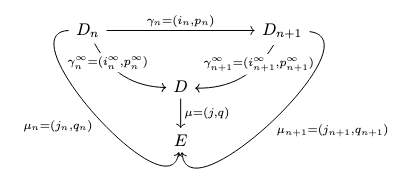
Let \((E, \mu_n)_{n \in \mathbb{N}}\) be any co-cone over the \(\omega\)-chain \((D_n, \gamma_n)_{n \in \mathbb{N}}\), where \(\mu_n = (j_n, q_n)\) is an embedding-projection pair for all \(n \in \mathbb{N}\) and \(\mu_n : D_n \rightarrow E\) satisfies \(\mu_{n+1} \circ \gamma_n = \mu_n\) for all \(n \in \mathbb{N}\).
Define the embedding-projection pair \(\mu=(j, q) : D_{\infty}\rightarrow E\) as follows:
\[j = \bigsqcup_{n=0}^{\infty}(j_n \circ p^{\infty}_n),\]
\[q = \bigsqcup_{n=0}^{\infty}(i^{\infty}_n \circ q_n).\]
Properties
- Identity A: \(j \circ i^{\infty}_k = j_k\). For all \(k \in \mathbb{N}\) and \(x \in D_k\),
\begin{align*}j(i^{\infty}_k(x)) &= \bigsqcup_{n=0}^{\infty}j_n(p^{\infty}_n(i^{\infty}_k(x))) \\&= \bigsqcup_{n=k}^{\infty}j_n(p^{\infty}_n(i^{\infty}_k(x))).\end{align*}
For all \(n \ge k\), \(p^{\infty}_n \circ i^{\infty}_k = i^n_k\) and \(j_n \circ i^n_k = j_k\), so we continue
\begin{align*}j(i^{\infty}_k(x)) &= \bigsqcup_{n=k}^{\infty}j_n(p^{\infty}_n(i^{\infty}_k(x))) \\&= \bigsqcup_{n=k}^{\infty}j_n( i^n_k(x)) \\&=\bigsqcup_{n=k}^{\infty}j_k(x) \\&= j_k(x).\end{align*}
- Identity B: \(q \circ j_n = i^{\infty}_n\). For any \(n \in \mathbb{N}\) and \(z \in D_n\):
\begin{align*}q(j_n(z)) &= \bigsqcup_{m=0}^{\infty}i^{\infty}_m(q_m(j_n(z))) \\&= \bigsqcup_{m=n}^{\infty}i^{\infty}_m(q_m(j_n(z))).\end{align*}
For all \(m \ge n\), \(q_m \circ j_n = p^m_n\) and \(i^{\infty}_m \circ p^m_n = i^{\infty}_n\), so we continue
\begin{align*}q(j_n(z)) &= \bigsqcup_{m=n}^{\infty}i^{\infty}_m(q_m(j_n(z))) \\&= \bigsqcup_{m=n}^{\infty}i^{\infty}_m(p^m_n(z))) \\&= \bigsqcup_{m=n}^{\infty} i^{\infty}_n(z) \\&= i^{\infty}_n(z).\end{align*}
Embedding-Projection Pair Verification
- \(q \circ j = \mathrm{id}_D\): We apply Identity B and exploit the continuity of \(q\):
\begin{align*}q(j(x)) &= q\left(\bigsqcup_{n=0}^{\infty} j_n(p^{\infty}_n(x))\right) \\&= \bigsqcup_{n=0}^{\infty} q(j_n(p^{\infty}_n(x))) \\&= \bigsqcup_{n=0}^{\infty}i^{\infty}_n(p^{\infty}_n(x)) \\&= \mathrm{id}_D(x).\end{align*}
- \(j \circ q \sqsubseteq \mathrm{id}_E\). We apply Identity B and exploit the continuity of \(j\):
\begin{align*}j(q(y)) &= j\left(\bigsqcup_{m=0}^{\infty}i^{\infty}_m(q_m(y))\right) \\&= \bigsqcup_{m=0}^{\infty}j(i^{\infty}_m(q_m(y))) \\&= \bigsqcup_{m=0}^{\infty}j_m(q_m(y)) \\&\sqsubseteq \bigsqcup_{m=0}^{\infty}\mathrm{id}_E(y) \\&= y.\end{align*}
Commutativity and Uniqueness
- Commutativity: (\(\mu \circ \gamma^{\infty}_k = \mu_k\)). Note that \(j \circ i^{\infty}_k = j_k\) holds by Identity A. Also, note that
\begin{align*}p^{\infty}_k(q(y)) &= \bigsqcup_{m=0}^{\infty} p^{\infty}_k(i^{\infty}_m(q_m(y))) \\&= \bigsqcup_{m=k}^{\infty} p^{\infty}_k(i^{\infty}_m(q_m(y))) \\&= \bigsqcup_{m=k}^{\infty} i^m_k(q_m(y)) \\&= q_k(y).\end{align*}
- Uniqueness: if \(\mu' = (j', q')\) satisfies \(\mu' \circ \gamma^{\infty}_n = \mu_n\) for all \(n \in \mathbb{N}\), then
\begin{align*}j'(x) &= j'\left( \bigsqcup_{n=0}^\infty i_n^\infty(p_n^\infty(x)) \right) \\&= \bigsqcup_{n=0}^\infty j'(i_n^\infty(p_n^\infty(x))) \\&= \bigsqcup_{n=0}^\infty j_n(p_n^\infty(x)) \\&= j(x),\end{align*}
and similarly, \(q' = q\), so \(\mu' = \mu\) and \(\mu\) is unique.
Necessity
Consider the following diagram:
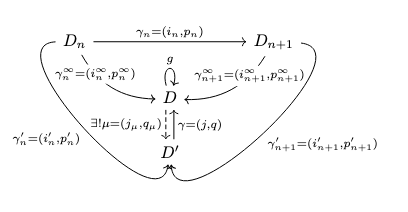
Suppose \((D, \gamma^{\infty}_n)_{n \in \mathbb{N}}\) is a colimit of \((D_n, \gamma_n)_{n \in \mathbb{N}}\) in \(\mathbf{CPO}^{ep}\). Define \(g : D \rightarrow D\) as
\[g = \bigsqcup_{n=0}^{\infty}(i^{\infty}_n \circ p^{\infty}_n).\]
Since \(i^{\infty}_n \circ p^{\infty}_n \le \mathrm{id}_D\) for all \(n \in \mathbb{N}\), it follows that \(g \le \mathrm{id}_D\).
- Fixed Point CPO: We define a sub-CPO consisting of the fixed points of \(g\) as follows:
\[D' = \{x \in D \mid g(x) = x\}.\]
Note that this is indeed a CPO. Since \(g\) is pointed by construction, it follows that \(g(\bot) = \bot\) and hence \(\bot \in D'\). Since \(g\) is continuous by construction, for any \(\omega\)-chain \((d_n)_{n \in \mathbb{N}}\) in \(D'\), it follows that
\begin{align*}g\left(\bigsqcup_{n \in \mathbb{N}}d_n\right) &= \bigsqcup_{n \in \mathbb{N}}g(d_n) \\&= \bigsqcup_{n \in \mathbb{N}}d_n,\end{align*}
and thus \(\bigsqcup_{n \in \mathbb{N}}d_n \in D'\).
- Co-cone: Because \(g(i^{\infty}_n(x)) = i^{\infty}_n(x)\), it follows that \(i^{\infty}_n(x) \in D'\) for all \(x \in D\), and hence we define \(i'_n : D_n \rightarrow D'\) as \(i'_n = i^{\infty}_n \vert_{D_n}^{D'}\) for all \(n \in \mathbb{N}\). We likewise define \(p'_n = p^{\infty}_n \circ j\) for all \(n \in \mathbb{N}\). Thus, we define \(\gamma'_n = (i'_n, p'_n)\) for all \(n \in \mathbb{N}\) and \(D', \gamma'_n)_{n \in \mathbb{N}}\) is an embedding-projection co-cone over \((D_n, \gamma_n)_{n \in \mathbb{N}}\).
- Universal Property: By the universal property of \((D_n, \gamma_n)_{n \in \mathbb{N}}\), there exists a unique mediating map \(\mu = (j_{\mu}, q_{\mu}) : D \rightarrow D'\) such that \(\mu \circ \gamma^{\infty}_n = \gamma'_n\). The composite \(\gamma \circ \mu : D \rightarrow D\) satisfies
\begin{align*}(\gamma \circ \mu) \circ \gamma^{\infty}_n &= \gamma \circ \gamma'_n \\&= (j \circ i'_n, p'_n \circ q) \\&= (i^{\infty}_n, p^{\infty}_n \circ j \circ q) \\&= (i^{\infty}_n, p^{\infty}_n \circ g) \\&= (i^{\infty}_n, p^{\infty}_n) \\&= \gamma^{\infty}_n.\end{align*}
By the uniqueness of mediating maps for colimits, it follows that \(\gamma \circ \mu = (\mathrm{id}_D, \mathrm{id}_D)\), which implies that \(j \circ j_{\mu} = \mathrm{id}_D\). Since \(j : D' \rightarrow D\) is an inclusion map, it follows that \(D = D'\) and hence \(g = \mathrm{id}_D\). \(\square\)
Construction of Colimits
We will now indicate how to construct colimits in \(\mathbf{CPO}^{ep}\).
Theorem (Construction of Colimits). Given an \(\omega\)-chain \((X_n, (i_n, p_n))_{n \in \mathbb{N}}\) in \(\mathbf{CPO}^{ep}\), the \(\omega\)-cocone \((X_{\infty}, (\varphi_n, \pi_n)_{n \in \mathbb{N}})\) defined as follows is an \(\omega\)-colimit of the \(\omega\)-chain:
\[X_{\infty} = \left\{x \in \prod_{n \in \mathbb{N}}X_n ~\middle|~ \forall n \in \mathbb{N}(x_n = p_n(x_{n+1}))\right\},\]
\[x \sqsubseteq y \Leftrightarrow \forall n \in \mathbb{N}(x_n \sqsubseteq_{X_n} y_n),\]
\[\left[\varphi_n(x)\right]_k = \begin{cases}p_k^n(x) & \text{if } k \lt n \\ x & \text{if } k = n \\ i_n^k & \text{if } k \gt n,\end{cases}\]
\[\pi_n(x) = x_n.\]
Proof. First, we confirm that \((X_{\infty}, \sqsubseteq)\) is a CPO.
Partial Order
Note that, since the order is defined pointwise and each order \(\sqsubseteq_{X_n}\) is a partial order, \(\sqsubseteq\) is likewise a partial order.
Suprema
For any \(\omega\)-chain \((x_n)_{n \in \mathbb{N}}\) in \(X_{\infty}\), the supremum is given by
\[\left(\bigsqcup_{n \in \mathbb{N}}x_n\right)(k) = \bigsqcup_{n \in \mathbb{N}}x_n(k).\]
Note that, for all \(n \in \mathbb{N}\), since \(x_n \sqsubseteq x_{n+1}\), by definition, \(x_n(k) \sqsubseteq x_{n+1}(k)\) and thus \((x_n(k))_{n \in \mathbb{N}}\) is an \(\omega\)-chain in \(X_k\) and thus the supremum \(\bigsqcup_{n \in \mathbb{N}}x_n(k)\) exists, so this is well-defined.
Note that this sequence is coherent:
\begin{align*}p_k\left[\left(\bigsqcup_{n \in \mathbb{N}}x_n\right)(k+1)\right] &= p_k\left(\bigsqcup_{n \in \mathbb{N}}x_n(k+1)\right) \\&= \bigsqcup_{n \in \mathbb{N}}p_k(x_n(k+1)) \\&= \bigsqcup_{n \in \mathbb{N}} x_n(k) \\&= \left(\bigsqcup_{n \in \mathbb{N}} x_n\right)(k).\end{align*}
By definition, \(x_n(k) \sqsubseteq_{X_k} \bigsqcup_{n \in \mathbb{N}}x_n(k)\) for all \(k \in \mathbb{N}\), so \(x_n \sqsubseteq \bigsqcup_{n \in \mathbb{N}}x_n\) and \(\bigsqcup_{n \in \mathbb{N}}x_n\) is an upper bound of the \(\omega\)-chain \((x_n)_{n \in \mathbb{N}}\).
Let \(y \in X_{\infty}\) be any other upper bound of the \(\omega\)-chain \((x_n)_{n \in \mathbb{N}}\). Then, by definition, \(x_n \sqsubseteq y\) for all \(n \in \mathbb{N}\), and thus, for all \(k \in \mathbb{N}\), \(x_n(k) \sqsubseteq y(k)\) and so \(y(k)\) is an upper bound of \((x_n(k))_{n \in \mathbb{N}}\) and thus \(\bigsqcup_{n \in \mathbb{N}} x_n(k) \sqsubseteq y(k)\) and hence \(\bigsqcup_{n \in \mathbb{N}} x_n \sqsubseteq y\) and so \(\bigsqcup_{n \in \mathbb{N}} x_n\) is the least upper bound of \((x_n)_{n \in \mathbb{N}}\).
Least Element
The least element \(\bot_{\infty} \in X_{\infty}\) is defined as
\[\bot_{\infty}(n) = \bot_n \in X_n.\]
For any element \(x \in X_{\infty}\), \(\bot_{\infty}(n) = \bot_n \sqsubseteq x_n\) for all \(n \in \mathbb{N}\) and so \(\bot_{\infty} \sqsubseteq x\).
Note that this sequence is coherent:
\[p_n(\bot_{\infty}(n+1)) = p_n(\bot_{n+1}) = \bot_n = \bot_{\infty}(n).\]
Embeddings
Next, we confirm that the embedding maps \(\varphi_n : X_n \rightarrow X_{\infty}\) are well-defined, i.e., that \(\varphi_n(x)\) is a coherent sequence for all \(x \in X_n\) and \(n \in \mathbb{N}\). Let \(n \in \mathbb{N}\) and \(x \in X_n\). We must show that \(p_k((\varphi_n(x))_{k+1}) = (\varphi_n(x))_k\) for all \(k \in \mathbb{N}\). There are three cases:
- \(k + 1 \lt n\): then \(k \lt n\) and thus \(p_k((\varphi_n(x))_{k+1}) = p_k(p_{k+1}^n(x)) = p_k^n(x) = (\varphi_n(x))_k\);
- \(k + 1 = n\): then \(k \lt n\) and thus \(p_k((\varphi_n(x))_{k+1}) = p_k(x) = (\varphi_n(x))_k\);
- \(k + 1 \gt n\): if \(k \gt n\) then \((\varphi_n(x))_k = i_n^k(x)\) and \(p_k((\varphi_n(x))_{k+1}) = p_k(i_n^{k+1}(x)) = p_k(i_k(i_n^k(x))) = i_n^k(x) = (\varphi_n(x))_k\); if \(k=n\), then \((\varphi_n(x))_k = x\) and \(p_k((\varphi_n(x))_{k+1}) = p_k(i_n^{k+1}(x)) = p_k(i_k^{k+1}(x)) = p_k(i_k(x)) = x = (\varphi_n(x))_k\).
Embedding-Projection Pairs
Next, we confirm that the pairs \((\varphi_n, \pi_n)\) are embedding-projection pairs for all \(n \in \mathbb{N}\).
First, note that, for all \(n \in \mathbb{N}\) and \(x \in X_n\),
\[\pi_n(\varphi_n(x)) = (\varphi_n(x))_n = x,\]
and thus \(\pi_n \circ \varphi_n = \mathrm{id}_{X_n}.\)
Next, we confirm that \(\varphi_n \circ \pi_n \sqsubseteq \mathrm{id}_{X_{\infty}}\) for all \(n \in \mathbb{N}\), i.e., that \(\varphi_n(\pi_n(x)) \sqsubseteq x\) for all \(x \in X_{\infty}\) which means that \((\varphi_n(x_n))_k \sqsubseteq x_k\) for all \(k \in \mathbb{N}\). There are three cases:
- \(k \lt n\): \((\varphi_n(x_n))_k = p_k^n(x_n) = x_k\); we can show by induction that, for any \(k \in \mathbb{N}\), \(p_k^{k+m}(x_{k+m}) = x_k\) for all \(m \in \mathbb{N}\):
- Base Case: \(m = 0\); \(p_k^k(x_k) = x_k\) holds by definition;
- Induction: suppose \(p_k^{k+m}(x_{k+m}) = x_k\) for some \(m \in \mathbb{N}\); then \(p_k^{k+m+1}(x_{k+m+1}) = p_k^{k+m}(p_{k+m}(x_{k+m+1})) = p_k^{k+m}(x_{k+m}) = x_k\);
- \(k = n\): \((\varphi_n(x_n))_k = x_n = x_k\);
- \(k \gt n\): \((\varphi_n(x_n))_k = i_n^k(x_n) \sqsubseteq x_k\); we can show by induction that, for any \(n \in \mathbb{N}\), \(i_n^{n+m}(x_n) \sqsubseteq x_{n+m}\):
- Base Case: \(m=0\); \(i_n^n(x_n) \sqsubseteq x_n\) holds by definition;
- Induction: suppose \(i_n^{n+m}(x_n) \sqsubseteq x_{n+m}\) for some \(m \in \mathbb{N}\); then \(i_n^{n+m+1}(x_n) = i_{n+m}(i_n^{n+m}(x_n)) \sqsubseteq i_{n+m}(x_{n+m})\) (by inductive hypothesis and monotonicity) and thus, since \(p_{n+m}(x_{n+m+1}) = x_{n+m}\), it follows that \(i_{n+m}(x_{n+m}) = i_{n+m}(p_{n+m}(x_{n+m+1})) \sqsubseteq x_{n+m+1}\).
Commutativity
We now indicate that \((X_{\infty}, (\varphi_n, \pi_n))_{n \in \mathbb{N}}\) is a cocone, i.e., that the following identities hold:
- \(\varphi_{n+1} \circ i_n = \varphi_n\),
- \(p_n \circ \pi_{n+1} = \pi_n\).
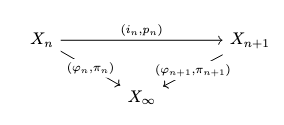
Let \(x \in X_n\). For all \(k \in \mathbb{N}\), the following identities hold:
- \((\varphi_{n+1}(i_n(x)))_k = (\varphi_n(x))_k\):
- Case 1: \(k \lt n+1\);
- Case 1a: \(k \lt n\): \((\varphi_{n+1}(i_n(x)))_k = p_k^{n+1}(i_n(x)) = p_k^n(p_n(i_n(x))) = p_k^n(x) = (\varphi_n(x))_k\);
- Case 1b: \(k = n\): \((\varphi_{n+1}(i_n(x)))_k = p_k^{n+1}(i_n(x)) = p_n^{n+1}(i_n(x)) = p_n(i_n(x)) = x = p_n^n(x) = (\varphi_n(x))_k\);
- Case 2: \(k=n+1\); \((\varphi_{n+1}(i_n(x)))_k = i_n(x) = i_n^{n+1}(x) = (\varphi_n(x))_k\);
- Case 3: \(k \gt n+1\); \((\varphi_{n+1}(i_n(x)))_k = i_{n+1}^k(i_n(x)) = i_n^k(x) = \varphi_n(x))_k\);
- Case 1: \(k \lt n+1\);
Let \(x \in X_{\infty}\). For all \(n \in \mathbb{N}\), \(p_n(\pi_{n+1}(x)) = p_n(x_{n+1}) = x_n = \pi_n(x)\).
Colimit
When \(k=n\), \((\varphi_n(\pi_n(x)))_k = \pi_n(x) = \pi_k(x) = x_k\). When \(k \gt n\), \((\varphi_n(\pi_n(x)))_k = p_k^n(\pi_n(x)) = p_k^n(x_n) = x_k\). Thus,
\begin{align*}\bigsqcup_{n=0}^{\infty}\varphi_n(\pi_n(x)) &= \bigsqcup_{n=k}^{\infty}\varphi_n(\pi_n(x)) \\&= \bigsqcup_{n=k}^{\infty}x_k \\&= x_k.\end{align*}
It then follows that
\[\left(\bigsqcup_{n=0}^{\infty}\varphi_n(\pi_n(x))\right)(k) = x_k\]
and thus
\[\bigsqcup_{n=0}^{\infty}\varphi_n(\pi_n(x)) = x\]
so
\[\bigsqcup_{n \in \mathbb{N}}(\varphi_n \circ \pi_n) = \mathrm{id}_{X_{\infty}}.\]
Thus, by the Characterization Lemma for \(\omega\)-colimits, \((X_{\infty}, (\varphi_n, \pi_n))_{n \in \mathbb{N}})\) is a colimit of the \(\omega\)-chain \((X_n, (i_n, p_n))_{n \in \mathbb{N}}\). \(\square\)
Functors
In this section, we will define the functors that characterize the recursive domain equations.
Definition (Lifting of a CPO). For any CPO \((D, \sqsubseteq)\), its lifting \((D_{\bot}, \sqsubseteq_{\bot})\) adjoins a least element \(\bot\) as follows:
- \(\bot \notin D\);
- \(D_{\bot} = D \cup \{\bot\}\);
- \(x \sqsubseteq_{\bot} y \Leftrightarrow x = \bot \text{ or } x,y \in D \text{ and } x \sqsubseteq y\).
The supremum of an \(\omega\)-chain in \(D_{\bot}\) is given by
\[\bigsqcup_{n \in \mathbb{N}} d_n = \begin{cases} \bot & \text{if } \forall n \in \mathbb{N} (d_n = \bot) \\ \bigsqcup_{n=N}^{\infty}d_n & \text{if } \exists N \in \mathbb{N} (d_N \ne \bot).\end{cases}\]
Definition (Lifting of a Map). For any continuous map \(f : D \rightarrow E\) between CPOs \(D\) and \(E\), the lifting \(f_{\bot} : D_{\bot} \rightarrow E_{\bot}\) is defined as follows:
\[f_{\bot}(x) = \begin{cases}\bot & \text{if } x = \bot \\ f(x) & \text{otherwise} \end{cases}.\]
Lemma. Let \((d_n)_{n \in \mathbb{N}}\) be an \(\omega\)-chain of continuous maps in \(\mathrm{Cont}(D, D)\) for a CPO \(D\) and let \((e_n)_{n \in \mathbb{N}}\) be an \(\omega\)-chain of continuous maps in \(\mathrm{Cont}(E, E)\) for a CPO \(E\) such that
\[\bigsqcup_{n \in \mathbb{N}}d_n = \mathrm{id}_{D}\]
and
\[\bigsqcup_{n \in \mathbb{N}}e_n = \mathrm{id}_{E};\]
then, for any map \(f \in \mathrm{Cont}(D, E)\),
\[\bigsqcup_{n \in \mathbb{N}}(e_n \circ f \circ d_n) = f.\]
Proof. Note that the sequence \((e_n(f(d_n(x))))_{n \in \mathbb{N}}\) is jointly monotone. Then:
\begin{align}\left(\bigsqcup_{n \in \mathbb{N}}(e_n \circ f \circ d_n)\right)(x) &= \bigsqcup_{n \in \mathbb{N}}(e_n \circ f \circ d_n)(x) \\&= \bigsqcup_{n \in \mathbb{N}}e_n(f(d_n(x))) \\&= \bigsqcup_{m \in \mathbb{N}}\bigsqcup_{n \in \mathbb{N}}e_m(f(d_n(x))) \\&= \bigsqcup_{m \in \mathbb{N}}e_m\left(\bigsqcup_{n \in \mathbb{N}}f(d_n(x))\right) \\&= \left(\bigsqcup_{m \in \mathbb{N}}e_m\right)\left(\bigsqcup_{n \in \mathbb{N}}f(d_n(x))\right) \\&= \left(\bigsqcup_{m \in \mathbb{N}}e_m\right)\left(f\left(\bigsqcup_{n \in \mathbb{N}}d_n(x)\right)\right) \\&= \left(\bigsqcup_{m \in \mathbb{N}}e_m\right)\left(f\left(\left(\bigsqcup_{n \in \mathbb{N}}d_n\right)(x)\right)\right) \\&= \left(\left(\bigsqcup_{m \in \mathbb{N}}e_m\right) \circ f \circ \left(\bigsqcup_{n \in \mathbb{N}}d_n\right)\right)(x) \\&= (\mathrm{id}_E \circ f \circ \mathrm{id}_D)(x) \\&= f(x).\end{align}
\(\square\)
Call-by-Name
For the call-by-name strategy, it is necessary to distinguish the bottom element of \(\mathrm{Cont}(D, D)\) (which is the constant map \(d \mapsto \bot\)) from non-termination; the former applies to terms like \((\lambda x . \Omega)\) for a divergent term \(\Omega\).
Definition (Call-by-name Functor). The call-by-name functor \(F_{\mathrm{n}} : \mathbf{CPO}^{ep} \rightarrow \mathbf{CPO}^{ep}\) is defined as follows:
- Objects: \(F_{\mathrm{n}}(D) = (\mathrm{Cont}(D, D))_{\bot}\);
- Arrows: \(F_{\mathrm{n}}(i, p) = (F_{\mathrm{n}}(i), F_{\mathrm{n}}(p))\), where
- \(F_{\mathrm{n}}(i) = f \mapsto \begin{cases}\bot & \text{if } f = \bot \\ i \circ f \circ p & \text{otherwise} \end{cases}\),
- \(F_{\mathrm{n}}(p) = g \mapsto \begin{cases}\bot & \text{if } g = \bot \\ p \circ g \circ i & \text{otherwise} \end{cases}\).
Theorem (Preservation of Colimits). The functor \(F_{\mathrm{n}}\) preserves all colimits of \(\omega\)-chains, i.e., for any \(\omega\)-chain \((X_n, (i_n, p_n))_{n \in \mathbb{N}}\) in \(\mathbf{CPO}^{ep}\), if the \(\omega\)-cocone \((X_{\infty}, (\varphi_n, \pi_n)_{n \in \mathbb{N}})\) is a colimit of this \(\omega\)-chain, then the \(\omega\)-cocone \((F_{\mathrm{n}}(X_{\infty}), (F_{\mathrm{n}}(\varphi_n), F_{\mathrm{n}}(\pi_n))_{n \in \mathbb{N}})\) is a colimit of the \(\omega\)-chain \((F_{\mathrm{n}}(X_n), (F_{\mathrm{n}}(i_n), F_{\mathrm{n}}(p_n)))_{n \in \mathbb{N}}\).
Proof. For any \(f \in (\mathrm{Cont}(X_{\infty}, X_{\infty}))_{\bot}\), if \(f = \bot\) then
\[(F_{\mathrm{n}}(\varphi_n) \circ F_{\mathrm{n}}(\pi_n))(\bot) = \bot = \mathrm{id}_{F_{\mathrm{n}}(X_{\infty})}(\bot).\]
If \(f \in \mathrm{Cont}(X_{\infty}, X_{\infty})\), the observe the following (where we utilize the above lemma and the Characterization Lemma):
\begin{align*}\left(\bigsqcup_{n \in \mathbb{N}}F_{\mathrm{n}}(\varphi_n) \circ F_{\mathrm{n}}(\pi_n)\right)(f) &= \bigsqcup_{n \in \mathbb{N}}(F_{\mathrm{n}}(\varphi_n) \circ F_{\mathrm{n}}(\pi_n))(f) \\&= \bigsqcup_{n \in \mathbb{N}}F_{\mathrm{n}}(\varphi_n)(F_{\mathrm{n}}(\pi_n)(f)) \\&= \bigsqcup_{n \in \mathbb{N}}F_{\mathrm{n}}(\varphi_n)(\pi_n \circ f \circ \varphi_n) \\&= \bigsqcup_{n \in \mathbb{N}}(\varphi_n \circ (\pi_n \circ f \circ \varphi_n) \circ \pi_n) \\&= \bigsqcup_{n \in \mathbb{N}}((\varphi_n \circ \pi_n) \circ f \circ (\varphi_n \circ \pi_n)) \\&= f \\&= \mathrm{id}_{F_{\mathrm{n}}(X_{\infty})}(f).\end{align*}
Thus, in all cases,
\[\bigsqcup_{n \in \mathbb{N}}F_{\mathrm{n}}(\varphi_n) \circ F_{\mathrm{n}}(\pi_n) = \mathrm{id}_{F_{\mathrm{n}}(X_{\infty})},\]
and so the result follows by the Characterization Lemma. \(\square\)
Call-by-Value
For the call-by-value strategy, computations are distinguished from values. Implicitly, we solve the recursive equation \((V, C) \cong (\mathrm{Cont}(V, C), V_{\bot})\) which implies that \(V \cong (\mathrm{Cont}(V, V_{\bot}))_{\bot}\).
Definition (Call-by-value Functor). The call-by-value functor \(F_{\mathrm{v}} : \mathbf{CPO}^{ep} \rightarrow \mathbf{CPO}^{ep}\) is defined as follows:
- Objects: \(F_{\mathrm{v}}(D, R) = (\mathrm{Cont}(D, D_{\bot}))_{\bot}\);
- Arrows: \(F_{\mathrm{v}}(i, p) = (F_{\mathrm{v}}(i), F_{\mathrm{v}}(p))\), where
- \(F_{\mathrm{v}}(i) = f \mapsto \begin{cases}\bot & \text{if } f = \bot \\ i_{\bot} \circ f \circ p & \text{otherwise} \end{cases}\),
- \(F_{\mathrm{v}}(p) = g \mapsto \begin{cases}\bot & \text{if } g = \bot \\ p_{\bot} \circ g \circ i & \text{otherwise} \end{cases}\).
Theorem (Preservation of Colimits). The functor \(F_{\mathrm{v}}\) preserves all colimits of \(\omega\)-chains, i.e., for any \(\omega\)-chain \((X_n, (i_n, p_n))_{n \in \mathbb{N}}\) in \(\mathbf{CPO}^{ep}\), if the \(\omega\)-cocone \((X_{\infty}, (\varphi_n, \pi_n)_{n \in \mathbb{N}})\) is a colimit of this \(\omega\)-chain, then the \(\omega\)-cocone \((F_{\mathrm{v}}(X_{\infty}), (F_{\mathrm{v}}(\varphi_n), F_{\mathrm{v}}(\pi_n))_{n \in \mathbb{N}})\) is a colimit of the \(\omega\)-chain \((F_{\mathrm{v}}(X_n), (F_{\mathrm{v}}(i_n), F_{\mathrm{v}}(p_n)))_{n \in \mathbb{N}}\).
Proof. For any \(f \in (\mathrm{Cont}(X_{\infty}, (X_{\infty})_{\bot}))_{\bot}\), if \(f = \bot\) then
\[(F_{\mathrm{v}}(\varphi_n) \circ F_{\mathrm{v}}(\pi_n))(\bot) = \bot = \mathrm{id}_{F_{\mathrm{v}}(X_{\infty})}(\bot).\]
Note that
\[\bigsqcup_{n \in \mathbb{N}}(\varphi_n \circ \pi_n)_{\bot} = \mathrm{id}_{(X_{\infty})_{\bot}}.\]
If \(f \in \mathrm{Cont}(X_{\infty}, (X_{\infty})_{\bot})\), the observe the following (where we utilize the above lemma and the Characterization Lemma):
\begin{align*}\left(\bigsqcup_{n \in \mathbb{N}}F_{\mathrm{v}}(\varphi_n) \circ F_{\mathrm{v}}(\pi_n)\right)(f) &= \bigsqcup_{n \in \mathbb{N}}(F_{\mathrm{v}}(\varphi_n) \circ F_{\mathrm{v}}(\pi_n))(f) \\&= \bigsqcup_{n \in \mathbb{N}}F_{\mathrm{v}}(\varphi_n)(F_{\mathrm{v}}(\pi_n)(f)) \\&= \bigsqcup_{n \in \mathbb{N}}F_{\mathrm{v}}(\varphi_n)((\pi_n)_{\bot} \circ f \circ \varphi_n) \\&= \bigsqcup_{n \in \mathbb{N}}((\varphi_n)_{\bot} \circ ((\pi_n)_{\bot} \circ f \circ \varphi_n) \circ \pi_n) \\&= \bigsqcup_{n \in \mathbb{N}}((\varphi_n \circ \pi_n)_{\bot} \circ f \circ (\varphi_n \circ \pi_n)) \\&= f \\&= \mathrm{id}_{F_{\mathrm{v}}(X_{\infty})}(f).\end{align*}
Thus, in all cases,
\[\bigsqcup_{n \in \mathbb{N}}F_{\mathrm{v}}(\varphi_n) \circ F_{\mathrm{v}}(\pi_n) = \mathrm{id}_{F_{\mathrm{v}}(X_{\infty})},\]
and so the result follows by the Characterization Lemma. \(\square\)
Initial Object
The initial object \(D_0\) in \(\mathbf{CPO}^{ep}\) is defined as follows:
\[D_0 = \{\bot\}.\]
For any object \(D\), since maps are pointed, there is a unique map \((i, p) : D_0 \rightarrow D\) defined as \(i(\bot) = \bot\) and \(p(d) = \bot\). These maps satisfy \((p \circ i)(\bot) = \bot\) and \((i \circ p)(d) = \bot \sqsubseteq d\) as required.
Initial Algebras and Fixed Points
In this section, we prove an important lemma about the construction of initial algebras.
Definition (Algebra for a Functor). An algebra for an functor \(F : \mathcal{C} \rightarrow \mathcal{C}\) on a category \(\mathcal{C}\) is a pair \((A, a)\) consisting of an object \(A\) of \(\mathcal{C}\) (called the carrier of the algebra) and an arrow \(a : F(A) \rightarrow A\) (called the operation of the algebra).
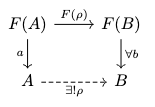
Definition (Initial Algebra). An initial algebra for a functor \(F : \mathcal{C} \rightarrow \mathcal{C}\) on a category \(\mathcal{C}\) is an algebra \((A, a)\) for \(F\) such that, for any algebra \((B, b)\) for \(F\), there exists a unique arrow \(\rho : A \rightarrow B\) such that \(\rho \circ a = b \circ F(\rho)\), i.e., the following diagram commutes:
Lemma (Fixed Point). Let \((A,a)\) be an initial algebra for a functor \(F\) on a category \(\mathcal{C}\). Then \(a\) is an isomorphism and \(F(A) \cong A\).
Proof. Consider the following diagram:
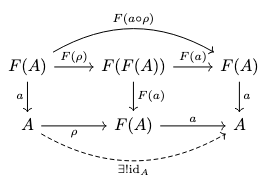
Since \((F(A), F(a))\) is an algebra for \(F\) and \((A,a)\) is initial, by definition, there exists a unique arrow \(\rho : A \rightarrow F(A)\) such that \(\rho \circ a = F(a) \circ F(\rho)\). It then follows that
\begin{align*}(a \circ \rho) \circ a &= a \circ (\rho \circ a) \\&= a \circ (F(a) \circ F(\rho)) \\&= a \circ F(a \circ \rho).\end{align*}
Since \((A,a)\) is initial, there exists a unique map, namely \(\mathrm{id}_A : A \rightarrow A\) such that \(\mathrm{id}_A \circ a = a \circ F(\mathrm{id}_A)\). However, \(a \circ \rho\) is another map such that \((a \circ \rho) \circ a = a \circ F(a \circ \rho)\), so \(a \circ \rho = \mathrm{id}_A\). It then follows that
\begin{align*}\rho \circ a &= F(a) \circ F(\rho) \\&= F(a \circ \rho) \\&= F(\mathrm{id}_A) \\&= \mathrm{id}_{F(A)}.\end{align*}
Since \(a \circ \rho = \mathrm{id}_A\) and \(\rho \circ a = \mathrm{id}_{F(A)}\), \(F(A) \cong A\). \(\square\)
Lemma (Initial Algebra). Let \(\mathcal{C}\) be any category with an initial object \(0_{\mathcal{C}}\) and all colimits of \(\omega\)-chains and \(F : \mathcal{C} \rightarrow \mathcal{C}\) be any functor that preserves colimits of \(\omega\)-chains. Let \((C_{\infty}, (\varphi_n)_{n \in \mathbb{N}})\) be the colimit of the \(\omega\)-chain \((F^n(0_{\mathcal{C}}), F^n(i))_{n \in \mathbb{N}}\), where \(i : 0_{\mathcal{C}} \rightarrow F(0_{\mathcal{C}})\) is the unique map from the initial object to \(F(0_{\mathcal{C}})\). Then there exists an arrow \(\theta : F(C_{\infty}) \rightarrow C_{\infty}\) such that \((C_{\infty}, \theta)\) is an initial algebra for \(F\).
Proof. Since \((C_{\infty}, (\varphi_n)_{n \in \mathbb{N}})\) is the colimit of the \(\omega\)-chain \((F^n(0_{\mathcal{C}}), F^n(i))_{n \in \mathbb{N}}\), the following diagram commutes for all \(n \in \mathbb{N}\):
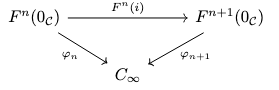
Since \(F\) preserves colimits of \(\omega\)-chains, the \(\omega\)-cocone \((F(C_{\infty}), (F(\varphi_n))_{n \in \mathbb{N}})\) is a colimit of the \(\omega\)-chain \((F(F^n(0_{\mathcal{C}})), F(F^n(i)))_{n \in \mathbb{N}}\) (equivalently \((F^{n+1}(0_{\mathcal{C}}), F^{n+1}(i))_{n \in \mathbb{N}}\)), and hence the following diagram commutes for all \(n \in \mathbb{N}\):
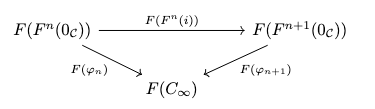
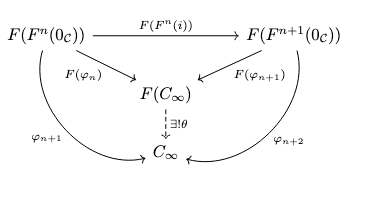
Since \((C_{\infty}, (\varphi_{n+1})_{n \in \mathbb{N}})\) is an \(\omega\)-cocone for the \(\omega\)-chain \((F^{n+1}(0_{\mathcal{C}}), F^{n+1}(i))_{n \in \mathbb{N}}\), by the universal property of colimits of \(\omega\)-chains, there exists a unique map \(\theta : F(C_{\infty}) \rightarrow C_{\infty}\) such that \(\theta \circ F(\varphi_n) = \varphi_{n+1}\) for all \(n \in \mathbb{N}\), i.e., the following diagram commutes:
Let \((C, c)\) be any algebra for \(F\). We define an \(\omega\)-cocone \((C, (c_n)_{n \in \mathbb{N}})\) where the maps \(c_n : F^{n+1}(0_{\mathcal{C}}) \rightarrow C\) are defined recursively as follows in terms of the unique map \(j : 0_{\mathcal{C}} \rightarrow C\) from the initial object into \(C\):
- \(c_0 = c \circ F(j)\),
- \(c_{n+1} = c \circ F(c_n)\).
We will verify by induction that this is indeed an \(\omega\)-cocone, i.e., that \(c_{n+1} \circ F^{n+1}(i) = c_n\) for all \(n \in \mathbb{N}\). When \(n=0\), note that
\begin{align*}c_1 \circ F(i) &= c \circ F(c_0) \circ F(i) \\&= c \circ F(c_0 \circ i),\end{align*}
and, since \(c_0 \circ i : 0_{\mathcal{C}} \rightarrow C\) and \(j : 0_{\mathcal{C}} \rightarrow C\) is unique, it follows that \(c_0 \circ i = j\) and hence \(c \circ F(c_0 \circ i) = c \circ F(j)\) and \(c_1 \circ F(i) = c \circ F(j) = c_0\). Next, suppose that \(c_{n+1} \circ F^{n+1}(i) = c_n\) for some \(n \in \mathbb{N}\). Then,
\begin{align*}c_{n+2} \circ F^{n+2}(i) &= c \circ F(c_{n+1}) \circ F^{n+2}(i) \\&= c \circ F(c_{n+1}) \circ F(F^{n+1}(i)) \\&= c \circ F(c_{n+1} \circ F^{n+1}(i)) \\&= c \circ F(c_n) \\&= c_{n+1}.\end{align*}
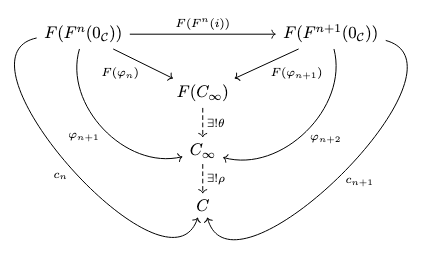
Since \((C_{\infty}, (\varphi_{n+1})_{n \in \mathbb{N}})\) is also a colimit of the \(\omega\)-chain \((F^{n+1}(0_{\mathcal{C}}), F^{n+1}(i))_{n \in \mathbb{N}}\), by the universal property of colimits of \(\omega\)-chains, there exists a unique arrow \(\rho : C_{\infty} \rightarrow C\) such that \(\rho \circ \varphi_{n+1} = c_n\) for all \(n \in \mathbb{N}\), i.e., the following diagram commutes:
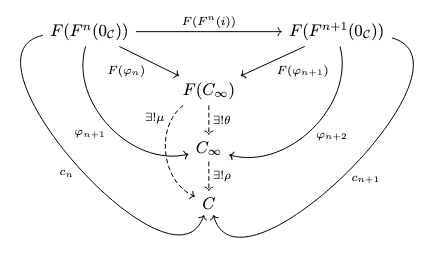
Similarly, since \((F(C_{\infty}), (F(\varphi_n))_{n \in \mathbb{N}})\) is a colimit of the \(\omega\)-chain \((F^{n+1}(0_{\mathcal{C}}), F^{n+1}(i))_{n \in \mathbb{N}}\), by the universal property of colimits of \(\omega\)-chains, there exists a unique arrow \(\mu : F(C_{\infty}) \rightarrow C\) such that \(\mu \circ F(\varphi_n) = c_n\) for all \(n \in \mathbb{N}\), i.e., the following diagram commutes:
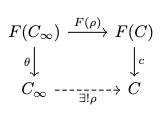
Our goal is to indicate that \(\rho\) is the unique map such that \(\rho \circ \theta = c \circ F(\rho)\), i.e., the unique map making the following diagram commute:
Note that, when \(n=0\), since \(\rho \circ \varphi_0 : 0_{\mathcal{C}} \rightarrow C\), it follows that \(\rho \circ \varphi_0 = j\), and thus
\begin{align*}c \circ F(\rho) \circ F(\varphi_0) &= c \circ F(\rho \circ \varphi_0) \\&= c \circ F(j) \\&= c_0.\circ\end{align*}
Likewise,
\begin{align*}c \circ F(\rho) \circ F(\varphi_{n+1}) &= c \circ F(\rho \circ \varphi_{n+1}) \\&= c \circ F(c_n) \\&= c_{n+1}.\end{align*}
Thus, for all \(n \in \mathbb{N}\), \((c \circ F(\rho)) \circ F(\varphi_n) = c_n\), and, since \(\mu\) is the unique mediating map, it follows that \(c \circ F(\rho) = \mu\).
Note also that
\begin{align*}\rho \circ \theta \circ F(\varphi_n) &= \rho \circ \varphi_{n+1} \\&= c_n.\end{align*}
It follows that \(\rho \circ \theta = \mu\) and hence \(\rho \circ \theta = c \circ F(\rho)\).
Finally, suppose that there exists another map \(\rho' : C_{\infty} \rightarrow C\) such that \(\rho' \circ \theta = c \circ F(\rho')\). When \(n=0\),
\begin{align*}\rho' \circ \varphi_1 &= \rho' \circ \theta \circ F(\varphi_0) \\&= c \circ F(\rho') \circ F(\varphi_0) \\&= c \circ F(\rho' \circ \varphi_0) \\&= c \circ F(j) \\&= c_0.\end{align*}
Likewise,
\begin{align*}\rho' \circ \varphi_{n+2} &= \rho' \circ \theta \circ F(\varphi_{n+1}) \\&= c \circ F(\rho') \circ F(\varphi_{n+1}) \\&= c \circ F(\rho' \circ \varphi_{n+1}) \\&= c \circ F(c_n) \\&= c_{n+1}.\end{align*}
Thus, for all \(n \in \mathbb{N}\), \(\rho' \circ \varphi_{n+1} = c_n\). Since \(\rho\) is the unique such mediating map, it follows that \(\rho = \rho'\). \(\square\)
Summary
We now summarize the results up to this point.
- The category \(\mathbf{CPO}^{ep}\) has all colimits of \(\omega\)-chains.
- The functors \(F_{\mathrm{v}}\) and \(F_{\mathrm{n}}\) used to define the call-by-value and call-by-name models, respectively, are locally continuous.
- By the local continuity lemma, the functors \(F_{\mathrm{v}}\) and \(F_{\mathrm{n}}\) preserve all colimits of \(\omega\)-chains.
- By the initial algebra lemma, there exist fixed points \(\mu F_{\mathrm{v}}\) and \(\mu F_{\mathrm{n}}\) in the category \(\mathbf{CPO}^{ep}\) such that \(F_{\mathrm{v}}(\mu F_{\mathrm{v}}) \cong \mu F_{\mathrm{v}}\) and \(F_{\mathrm{n}}(\mu F_{\mathrm{n}}) \cong \mu F_{\mathrm{n}}\) and \(\mu F_{\mathrm{v}}\) is the carrier of the initial algebra for \(F_{\mathrm{v}}\) and \(\mu F_{\mathrm{n}}\) is the carrier of the initial algebra for \(F_{\mathrm{n}}\). We designate these fixed points as \(D_{\infty}^{\mathrm{v}} = \mu F_{\mathrm{v}}\) and \(D_{\infty}^{\mathrm{n}} = \mu F_{\mathrm{n}}\). Thus, \(D_{\infty}^{\mathrm{v}} \cong (\mathrm{Cont}(D_{\infty}^{\mathrm{v}}, (D_{\infty}^{\mathrm{v}})_{\bot}))_{\bot}\) and \(D_{\infty}^{\mathrm{n}} \cong (\mathrm{Cont}(D_{\infty}^{\mathrm{n}}, D_{\infty}^{\mathrm{n}}))_{\bot}\).
- By the bilimit lemma, since these fixed points are colimits within \(\mathbf{CPO}^{ep}\), there is a corresponding colimit in \(\mathbf{CPO}^e\). By the isomorphism lemma, the carrier of this colimit is also the carrier of an initial algebra and so \(D_{\infty}^{\mathrm{v}}\) is the fixed point of \(F_{\mathrm{v}}^e\) and \(D_{\infty}^{\mathrm{n}}\) is the fixed point of \(F_{\mathrm{n}}^e\) in the category \(\mathbf{CPO}^e\).
- By the bilimit lemma and isomorphism lemma, since \(\mathbf{CPO}^{ep}\) has all colimits, so does \((\mathbf{CPO}^p)^{op}\). Likewise, since the functor \(F_{\mathrm{v}}\) preserves all colimits, so does the functor \((F_{\mathrm{v}}^p)^{op}\). This means that there exists a fixed point \(\mu (F_{\mathrm{v}}^p)^{op}\) in \((\mathbf{CPO}^p)^{op}\), which is a fixed point \(\nu F_{\mathrm{v}}^p\) of \(F_{\mathrm{v}}^p\) in \(\mathbf{CPO}^p\) (and carries the respective final coalgebra). Moreover, \(\nu F_{\mathrm{v}}^p = D_{\infty}^{\mathrm{v}}\). Thus, there is a coincidence of the carriers for the initial and final coalgebras. Similarly, there is a fixed point \(\nu F_{\mathrm{n}}^p = D_{\infty}^{\mathrm{n}}\).
The PERs
We will now define the PERs used for each model.
Call-by-Name
We define a PER as follows: first, we define a monotone map \(F : \mathcal{P}(D^{\mathrm{n}}_{\infty} \times D^{\mathrm{n}}_{\infty})\) as follows:
\[F(R) = \left\{(d_1, d_2) \in D^{\mathrm{n}}_{\infty} \times D^{\mathrm{n}}_{\infty} \middle| \begin{aligned}& d_1 \ne \bot \Rightarrow d_2 \ne \bot \land \forall e_1, e_2 \in D^{\mathrm{n}}_{\infty}(e_1 \mathrel{R} e_2 \Rightarrow (d_1 \cdot e_1) \mathrel{R} (d_2 \cdot e_2)) \\ &\land \\ & d_2 \ne \bot \Rightarrow d_1 \ne \bot \land \forall e_1, e_2 \in D^{\mathrm{n}}_{\infty}(e_1 \mathrel{R} e_2 \Rightarrow (d_1 \cdot e_1) \mathrel{R} (d_2 \cdot e_2)) \end{aligned}\right\}.\]
By the Tarski-Knaster theorem, there exists a greatest fixed point of this map:
\[R^{\mathrm{n}}_{\infty} = \nu F.\]
Thus, since \(F(R^{\mathrm{n}}_{\infty}) = R^{\mathrm{n}}_{\infty}\), it follows that
\[d_1 \mathrel{R^{\mathrm{n}}_{\infty}} d_2 \Leftrightarrow \begin{aligned}& d_1 \ne \bot \Rightarrow d_2 \ne \bot \land \forall e_1, e_2 \in D^{\mathrm{n}}_{\infty}(e_1 \mathrel{R^{\mathrm{n}}_{\infty}} e_2 \Rightarrow (d_1 \cdot e_1) \mathrel{R^{\mathrm{n}}_{\infty}} (d_2 \cdot e_2)) \\ &\land \\ & d_2 \ne \bot \Rightarrow d_1 \ne \bot \land \forall e_1, e_2 \in D^{\mathrm{n}}_{\infty}(e_1 \mathrel{R^{\mathrm{n}}_{\infty}} e_2 \Rightarrow (d_1 \cdot e_1) \mathrel{R^{\mathrm{n}}_{\infty}} (d_2 \cdot e_2)) \end{aligned}.\]
Call-by-Value
We define a PER as follows: first, we define a monotone map \(F : \mathcal{P}(D^{\mathrm{v}}_{\infty} \times D^{\mathrm{v}}_{\infty})\) as follows:
\[F(R) = \left\{(d_1, d_2) \in D^{\mathrm{v}}_{\infty} \times D^{\mathrm{v}}_{\infty} \middle| \begin{aligned}& d_1 \ne \bot \Rightarrow d_2 \ne \bot \land \forall e_1, e_2 \in D^{\mathrm{v}}_{\infty}(e_1 \ne \bot \land e_2 \ne \bot \land e_1 \mathrel{R} e_2 \Rightarrow (d_1 \cdot e_1) \mathrel{R} (d_2 \cdot e_2)) \\ &\land \\ & d_2 \ne \bot \Rightarrow d_1 \ne \bot \land \forall e_1, e_2 \in D^{\mathrm{v}}_{\infty}(e_1 \ne \bot \land e_2 \ne \bot \land e_1 \mathrel{R} e_2 \Rightarrow (d_1 \cdot e_1) \mathrel{R} (d_2 \cdot e_2)) \end{aligned}\right\}.\]
By the Tarski-Knaster theorem, there exists a greatest fixed point of this map:
\[R^{\mathrm{v}}_{\infty} = \nu F.\]
Thus, since \(F(R^{\mathrm{v}}_{\infty}) = R^{\mathrm{v}}_{\infty}\), it follows that
\[d_1 \mathrel{R^{\mathrm{v}}_{\infty}} d_2 \Leftrightarrow \begin{aligned}& d_1 \ne \bot \Rightarrow d_2 \ne \bot \land \forall e_1, e_2 \in D^{\mathrm{v}}_{\infty}(e_1 \ne \bot \land e_2 \ne \bot \land e_1 \mathrel{R^{\mathrm{v}}_{\infty}} e_2 \Rightarrow (d_1 \cdot e_1) \mathrel{R^{\mathrm{v}}_{\infty}} (d_2 \cdot e_2)) \\ &\land \\ & d_2 \ne \bot \Rightarrow d_1 \ne \bot \land \forall e_1, e_2 \in D^{\mathrm{v}}_{\infty}(e_1 \ne \bot \land e_2 \ne \bot \land e_1 \mathrel{R^{\mathrm{v}}_{\infty}} e_2 \Rightarrow (d_1 \cdot e_1) \mathrel{R^{\mathrm{v}}_{\infty}} (d_2 \cdot e_2)) \end{aligned}.\]
The Models
Now we are prepared to define the models.
Call-by-Name
The call-by-name model \(\mathcal{M}_{\mathrm{n}}\) is defined as follows:
- Semantic Domain: \(D_{\infty}^{\mathrm{n}}\);
- PER: \(R_{\infty}^{\mathrm{n}}\);
- Application: for all \(d_1, d_2 \in D_{\infty}^{\mathrm{n}}\), \[d_1 \cdot d_2 = \begin{cases}\bot & \text{if } \theta_{\mathrm{n}}(d_1) = \bot \\ \theta_{\mathrm{n}}(d_1)(d_2) & \text{otherwise} \end{cases}\];
- Denotation:
- Variables: \(\llbracket x \rrbracket_{\rho} = \rho(x)\) for all variables \(x \in \mathcal{V}\) and environments \(\rho \in \mathrm{Env}(R_{\infty}^{\mathrm{n}})\);
- Abstraction: \(\llbracket (\lambda x . M) \rrbracket_{\rho} = \theta^{-1}_{\mathrm{n}}\left(d \mapsto \llbracket M \rrbracket_{\rho[x \mapsto d]}\right)\) for all variables \(x \in \mathcal{V}\), terms \(M \in \Lambda\), and environments \(\rho \in \mathrm{Env}(R_{\infty}^{\mathrm{n}})\);
- Application: \(\llbracket (MN) \rrbracket_{\rho} = \llbracket M \rrbracket_{\rho} \cdot \llbracket N \rrbracket_{\rho}\) for all terms \(M, N \in \Lambda\), and environments \(\rho \in \mathrm{Env}(R_{\infty}^{\mathrm{n}})\).
We verify the model axioms.
Lemma (Bottom Uniqueness). For any \(x \in D^{\mathrm{n}}_{\infty}\), \(x \mathrel{R_{\infty}^{\mathrm{n}}} \bot\) if and only if \(x = \bot\) and hence the equivalence class of \(\bot\) is a singleton set, i.e., \([\bot] = \{\bot\}\).
Proof. Suppose \(x \mathrel{R_{\infty}^{\mathrm{n}}} \bot\). Then, if \(x \ne \bot\), it follows that \(\bot \ne \bot\), a contradiction, so \(x = \bot\). Conversely, it is vacuously the case that \(\bot \mathrel{R_{\infty}^{\mathrm{n}}} \bot\). \(\square\)
Continuity
We confirm that the denotation of abstractions \(\llbracket (\lambda x . M) \rrbracket_{\rho} = \theta_{\mathrm{n}}^{-1}\left(d \mapsto \llbracket M \rrbracket_{\rho[x \mapsto d]}\right)\) is well-defined, i.e., that the function \(d \mapsto \llbracket M \rrbracket_{\rho[x \mapsto d]}\) is indeed a continuous map. We proceed by structural induction on the body \(M\) of the abstraction.
- Variables \((M=y)\).
- Case 1: \((y=x)\). Then \(d \mapsto \llbracket x \rrbracket_{\rho[x \mapsto d]}\) is simply the identity map \(d \mapsto d\), which is continuous.
- Case 2: \((y \ne x)\). Then \(d \mapsto \llbracket y \rrbracket_{\rho[x \mapsto d]}\) is simply the constant map \(d \mapsto \rho(y)\), which is continuous.
- Abstractions \((M = (\lambda y . M'))\). By definition, \[d \mapsto \llbracket (\lambda y . M') \rrbracket_{\rho[x \mapsto d]} = d \mapsto \theta_{\mathrm{n}}^{-1}\left(d' \mapsto \llbracket M' \rrbracket_{\rho[x \mapsto d][y \mapsto d']}\right).\] By inductive hypothesis on the subterm \(M'\), the map \(d' \mapsto \llbracket M' \rrbracket_{\rho[x \mapsto d][y \mapsto d']}\) is continuous for every value of \(d\), and hence the expression \(\theta_{\mathrm{n}}^{-1}\left(d' \mapsto \llbracket M' \rrbracket_{\rho[x \mapsto d][y \mapsto d']}\right)\) is well-defined and the composite map \(d \mapsto \theta_{\mathrm{n}}^{-1}\left(d' \mapsto \llbracket M' \rrbracket_{\rho[x \mapsto d][y \mapsto d']}\right)\) is continuous since it is the composition of two continuous maps.
- Applications \(M = (M_1M_2)\). By definition, \begin{align*}d \mapsto \llbracket (M_1M_2) \rrbracket_{\rho[x \mapsto d]} &= d \mapsto \llbracket M_1 \rrbracket_{\rho[x \mapsto d]} \cdot \llbracket M_1 \rrbracket_{\rho[x \mapsto d]} \\&= d \mapsto \theta_{\mathrm{n}}\left(\llbracket M_1 \rrbracket_{\rho[x \mapsto d]}\right)\left(\llbracket M_2 \rrbracket_{\rho[x \mapsto d]}\right).\end{align*} By inductive hypothesis on the sub-terms \(M_1\) and \(M_2\), the maps \(d \mapsto \llbracket M_1 \rrbracket_{\rho[x \mapsto d]}\) and \(d \mapsto \llbracket M_2 \rrbracket_{\rho[x \mapsto d]}\) are continuous. By definition, the map \(\theta_{\mathrm{n}}\left(\llbracket M_1 \rrbracket_{\rho[x \mapsto d]}\right)\) is continuous, and hence so is the composite map \(d \mapsto \theta_{\mathrm{n}}\left(\llbracket M_1 \rrbracket_{\rho[x \mapsto d]}\right)\left(\llbracket M_2 \rrbracket_{\rho[x \mapsto d]}\right)\).
Well-Definedness
We confirm that \(\llbracket M \rrbracket_{\rho} \in \mathrm{dom}(R^{\mathrm{n}}_{\infty})\) for all terms \(M \in \Lambda\). we proceed by structural induction on \(M\).
- Variables: \((M=x)\); \(\llbracket x \rrbracket_{\rho} = \rho(x) \in \mathrm{dom}(R^{\mathrm{n}}_{\infty})\) by construction;
- Abstractions: \((M = (\lambda x . M'))\). Suppose \(\llbracket (\lambda x . M') \rrbracket_{\rho} \ne \bot\). By definition, \(\llbracket (\lambda x . M') \rrbracket_{\rho} = \theta_{\mathrm{n}}^{-1}(d \mapsto \llbracket M' \rrbracket_{\rho[x \mapsto d]})\). Suppose \(e_1, e_2 \in D^{\mathrm{n}}_{\infty}\) and \(e_1 \mathrel{R^{\mathrm{n}}_{\infty}} e_2\). By definition, since \(\llbracket (\lambda x . M') \rrbracket_{\rho} \ne \bot\), it follows that \(\llbracket (\lambda x . M') \rrbracket_{\rho} \cdot e_1 = \theta_{\mathrm{n}}(\theta_{\mathrm{n}}^{-1}(d \mapsto \llbracket M' \rrbracket_{\rho[x \mapsto d]}))(e_1) = \llbracket M' \rrbracket_{\rho[x \mapsto e_1]}\). Likewise, \(\llbracket (\lambda x . M') \rrbracket_{\rho} \cdot e_2 = \llbracket M' \rrbracket_{\rho[x \mapsto e_2]}\). By Environmental Consistency, since \(e_1 \mathrel{R^{\mathrm{n}}_{\infty}} e_2\), it follows that \(\llbracket M' \rrbracket_{\rho[x \mapsto e_1]} \mathrel{R^{\mathrm{n}}_{\infty}} \llbracket M' \rrbracket_{\rho[x \mapsto e_2]}\). Thus \(\llbracket (\lambda x . M') \rrbracket_{\rho} \mathrel{R^{\mathrm{n}}_{\infty}} \llbracket (\lambda x . M') \rrbracket_{\rho}\) and so \(\llbracket (\lambda x . M') \rrbracket_{\rho} \in \mathrm{dom}(R^{\mathrm{n}}_{\infty})\).
- Applications: \((M = (NP))\). By inductive hypothesis, \(\llbracket N \rrbracket_{\rho} \in \mathrm{dom}(R^{\mathrm{n}}_{\infty})\) and \(\llbracket P \rrbracket_{\rho} \in \mathrm{dom}(R^{\mathrm{n}}_{\infty})\). By definition, \(\llbracket (NP) \rrbracket_{\rho} = \llbracket N \rrbracket_{\rho} \cdot \llbracket P \rrbracket_{\rho}\), and by Congruence, \(\llbracket (MN) \rrbracket_{\rho} \mathrel{R^{\mathrm{n}}_{\infty}} \llbracket (MN) \rrbracket_{\rho}\).
Thus, the semantic denotation map is well-defined.
Congruence
Let \(f,g,x,y \in D^{\mathrm{n}}_{\infty}\) and suppose that \(f \mathrel{R^{\mathrm{n}}_{\infty}} g\) and \(x \mathrel{R^{\mathrm{n}}_{\infty}} y\).
- If \(f = \bot\) and \(g = \bot\), then \(f \cdot x = \bot\) and \(g \cdot y = \bot\) and it is vacuously the case that \(\bot \mathrel{R^{\mathrm{n}}_{\infty}} \bot\).
- If \(f \ne \bot\), then, since \(f \mathrel{R^{\mathrm{n}}_{\infty}} g\), it follows that \(g \ne \bot\) and \((f \cdot x) \mathrel{R^{\mathrm{n}}_{\infty}} (g \cdot y)\).
- Similarly, if \(g \ne \bot\), then, since \(f \mathrel{R^{\mathrm{n}}_{\infty}} g\), it follows that \(f \ne \bot\) and \((f \cdot x) \mathrel{R^{\mathrm{n}}_{\infty}} (g \cdot y)\).
Thus, in all cases, congruence is satisfied.
Extensionality
Let \(f,g \in D^{\mathrm{n}}_{\infty}\) and suppose that, for all \(x,y \in D^{\mathrm{n}}_{\infty}\), \((f \cdot x) \mathrel{R^{\mathrm{n}}_{\infty}} (g \cdot y)\) whenever \(x \mathrel{R^{\mathrm{n}}_{\infty}} y\).
If \(f \ne \bot\), then \(\theta_{\mathrm{n}}(f) \ne \bot\) since \(\theta_{\mathrm{n}}\) is a pointed map and a one-to-one map. This means that \(\theta_{\mathrm{n}}(f) \in \mathrm{Cont}(D^{\mathrm{n}}_{\infty}, D^{\mathrm{n}}_{\infty})\); thus, for all \(x \in D^{\mathrm{n}}_{\infty}\), \(f \cdot x = \theta_{\mathrm{n}}(f)(x) \ne \bot\). Suppose that \(g = \bot\). Then \(g \cdot x = \bot\) for all \(x \in D^{\mathrm{n}}_{\infty}\). It follows by the Bottom Uniqueness lemma that \(g \cdot x \mathrel{R^{\mathrm{n}}_{\infty}} \bot\) and \(f \cdot x \not \mathrel{R^{\mathrm{n}}_{\infty}} \bot\) and \(\bot \mathrel{R^{\mathrm{n}}_{\infty}} \bot\), which contradicts the hypothesis above; thus, \(g \ne \bot\). The condition \((f \cdot x) \mathrel{R^{\mathrm{n}}_{\infty}} (g \cdot y)\) whenever \(x \mathrel{R^{\mathrm{n}}_{\infty}} y\) is satisfied by hypothesis. A symmetric argument shows that if \(g \ne \bot\) the \(f \ne \bot\) and the condition \((f \cdot x) \mathrel{R^{\mathrm{n}}_{\infty}} (g \cdot y)\) whenever \(x \mathrel{R^{\mathrm{n}}_{\infty}} y\) is satisfied by hypothesis.
Thus, extensionality is satisfied.
Variable Assigment
This is satisfied by the very definition of \(\llbracket x \rrbracket_{\rho}\).
Semantic Abstraction
By definition, \(\llbracket (\lambda x . M) \rrbracket_{\rho} \cdot d = \llbracket M \rrbracket_{\rho[x \mapsto d]}\), so, since \(\llbracket M \rrbracket_{\rho[x \mapsto d]} \in \mathrm{dom}(R_{\infty}^{\mathrm{n}})\), then \(\llbracket (\lambda x . M) \rrbracket_{\rho} \cdot d \mathrel{R_{\infty}^{\mathrm{n}}} \llbracket M \rrbracket_{\rho[x \mapsto d]}\).
Applicative Consistency
Note that, if \(a,b \in \mathrm{dom}(R^{\mathrm{n}}_{\infty})\), then, by congruence, it follows that \((a \cdot b) \mathrel{R^{\mathrm{n}}_{\infty}} (a \cdot b)\).
By definition, \(\llbracket (MN) \rrbracket_{\rho} = \llbracket M \rrbracket_{\rho} \cdot \llbracket N \rrbracket_{\rho}\), so, since \(\llbracket M\rrbracket_{\rho} \in \mathrm{dom}(R_{\infty}^{\mathrm{n}})\) and \(\llbracket N \rrbracket_{\rho} \in \mathrm{dom}(R_{\infty}^{\mathrm{n}})\), it follows that \(\llbracket M \rrbracket_{\rho} \cdot \llbracket N \rrbracket_{\rho} \in \mathrm{dom}(R_{\infty}^{\mathrm{n}})\) and thus \(\llbracket (MN) \rrbracket_{\rho} \mathrel{R_{\infty}^{\mathrm{n}}} \llbracket M \rrbracket_{\rho} \cdot \llbracket N \rrbracket_{\rho}\).
Environmental Consistency
We proceed by structural induction on terms.
- Variables: there is only one free variable in a term \(x\) consisting of a single variable, namely \(x\) itself; if \(\rho(x) = \rho'(x)\) then \(\llbracket x \rrbracket_{\rho} = \llbracket x \rrbracket_{\rho'}\).
- Abstractions: Suppose that\(\rho(y) = \rho'(y)\) for all \(y \in \mathrm{Free}(\lambda x . M)\). Since \(\mathrm{Free}(M) = \mathrm{Free}(\lambda x . M) \cup \{x\}\), it follows that \(\rho[x \mapsto d](y) = \rho'[x \mapsto d](y)\) for all \(y \in \mathrm{Free}(M)\) and \(d \in \mathrm{dom}(R_{\infty}^{\mathrm{n}})\), and hence, by inductive hypothesis, \(\llbracket M \rrbracket_{\rho[x \mapsto d]} \mathrel{R_{\infty}^{\mathrm{n}}} \llbracket M \rrbracket_{\rho'[x \mapsto d]}\). It follows that \((d \mapsto \llbracket M \rrbracket_{\rho[x \mapsto d]})(d) \mathrel{R_{\infty}^{\mathrm{n}}} (d \mapsto \llbracket M \rrbracket_{\rho'[x \mapsto d]})(d)\) for all \(d \in \mathrm{dom}(R_{\infty}^{\mathrm{n}})\). This means that \(\theta_{\mathrm{n}}(\theta^{-1}_{\mathrm{n}}(d \mapsto \llbracket M \rrbracket_{\rho[x \mapsto d]}))(d) \mathrel{R_{\infty}^{\mathrm{n}}} \theta_{\mathrm{n}}(\theta^{-1}_{\mathrm{n}}(d \mapsto \llbracket M \rrbracket_{\rho'[x \mapsto d]}))(d)\) and hence \(\theta^{-1}_{\mathrm{n}}(d \mapsto \llbracket M \rrbracket_{\rho[x \mapsto d]}) \cdot d \mathrel{R_{\infty}^{\mathrm{n}}} \theta^{-1}_{\mathrm{n}}(d \mapsto \llbracket M \rrbracket_{\rho'[x \mapsto d]}) \cdot d\), which, by extensionality, implies that \(\theta^{-1}_{\mathrm{n}}(d \mapsto \llbracket M \rrbracket_{\rho[x \mapsto d]}) \mathrel{R_{\infty}^{\mathrm{n}}} \theta^{-1}_{\mathrm{n}}(d \mapsto \llbracket M \rrbracket_{\rho'[x \mapsto d]})\). Thus, \(\llbracket (\lambda x . M) \rrbracket_{\rho} \mathrel{R_{\infty}^{\mathrm{n}}} \llbracket (\lambda x . M) \rrbracket_{\rho'}\).
- Applications: Suppose that\(\rho(y) = \rho'(y)\) for all \(y \in \mathrm{Free}(MN)\). Then, since \(\mathrm{Free}(MN) = \mathrm{Free}(M) \cup \mathrm{Free}(N)\), it follows, by inductive hypothesis, that \(\llbracket M \rrbracket_{\rho} \mathrel{R_{\infty}^{\mathrm{n}}} \llbracket M \rrbracket_{\rho'}\) and \(\llbracket N \rrbracket_{\rho} \mathrel{R_{\infty}^{\mathrm{n}}} \llbracket N \rrbracket_{\rho'}\). Then, by congruence, it follows that \(\llbracket M \rrbracket_{\rho} \cdot \llbracket N \rrbracket_{\rho} \mathrel{R_{\infty}^{\mathrm{n}}} \llbracket M \rrbracket_{\rho} \cdot \llbracket N \rrbracket_{\rho'}\) and hence \(\llbracket (MN) \rrbracket_{\rho} \mathrel{R_{\infty}^{\mathrm{n}}} \llbracket (MN) \rrbracket_{\rho'}\).
Call-by-Value
The call-by-value model \(\mathcal{M}_{\mathrm{v}}\) is defined as follows:
- Semantic Domain: \(D_{\infty}^{\mathrm{v}}\);
- PER: \(R_{\infty}^{\mathrm{v}}\);
- Application: for all \(d_1, d_2 \in D_{\infty}^{\mathrm{v}}\), \[d_1 \cdot d_2 = \begin{cases}\bot & \text{if } \theta_{\mathrm{v}}(d_1) = \bot \text{ or } \theta_{\mathrm{v}}(d_1)(d_2) = \bot \\ \theta_{\mathrm{v}}(d_1)(d_2) & \text{otherwise} \end{cases}\];
- Denotation:
- Variables: \(\llbracket x \rrbracket_{\rho} = \rho(x)\) for all variables \(x \in \mathcal{V}\) and environments \(\rho \in \mathrm{Env}(R_{\infty}^{\mathrm{v}})\);
- Abstraction: \(\llbracket (\lambda x . M) \rrbracket_{\rho} = \theta^{-1}_{\mathrm{v}}\left(d \mapsto \llbracket M \rrbracket_{\rho[x \mapsto d]}\right)\) for all variables \(x \in \mathcal{V}\), terms \(M \in \Lambda\), and environments \(\rho \in \mathrm{Env}(R_{\infty}^{\mathrm{v}})\);
- Application: \(\llbracket (MN) \rrbracket_{\rho} = \llbracket M \rrbracket_{\rho} \cdot \llbracket N \rrbracket_{\rho}\) for all terms \(M, N \in \Lambda\), and environments \(\rho \in \mathrm{Env}(R_{\infty}^{\mathrm{v}})\).
We verify the model axioms.
Lemma (Bottom Uniqueness). For all \(x \in D^{\mathrm{v}}_{\infty}\), \(x \mathrel{R^{\mathrm{v}}_{\infty}} \bot\) if and only if \(x = \bot\).
Proof. If \(x \mathrel{R^{\mathrm{v}}_{\infty}} \bot\), then if \(x \ne \bot\), it follows that \(\bot \ne \bot\), a contradiction. Thus \(x = \bot\). Conversely, \(\bot \mathrel{R^{\mathrm{v}}_{\infty}} \bot\) holds vacuously. \(\square\)
Continuity
We confirm that the denotation of abstractions \(\llbracket (\lambda x . M) \rrbracket_{\rho} = \theta_{\mathrm{v}}^{-1}\left(d \mapsto \llbracket M \rrbracket_{\rho[x \mapsto d]}\right)\) is well-defined, i.e., that the function \(d \mapsto \llbracket M \rrbracket_{\rho[x \mapsto d]}\) is indeed a continuous map. We proceed by structural induction on the body \(M\) of the abstraction.
- Variables \((M=y)\).
- Case 1: \((y=x)\). Then \(d \mapsto \llbracket x \rrbracket_{\rho[x \mapsto d]}\) is simply the identity map \(d \mapsto d\), which is continuous.
- Case 2: \((y \ne x)\). Then \(d \mapsto \llbracket y \rrbracket_{\rho[x \mapsto d]}\) is simply the constant map \(d \mapsto \rho(y)\), which is continuous.
- Abstractions \((M = (\lambda y . M'))\). By definition, \[d \mapsto \llbracket (\lambda y . M') \rrbracket_{\rho[x \mapsto d]} = d \mapsto \theta_{\mathrm{v}}^{-1}\left(d' \mapsto \llbracket M' \rrbracket_{\rho[x \mapsto d][y \mapsto d']}\right).\] By inductive hypothesis on the subterm \(M'\), the map \(d' \mapsto \llbracket M' \rrbracket_{\rho[x \mapsto d][y \mapsto d']}\) is continuous for every value of \(d\), and hence the expression \(\theta_{\mathrm{v}}^{-1}\left(d' \mapsto \llbracket M' \rrbracket_{\rho[x \mapsto d][y \mapsto d']}\right)\) is well-defined and the composite map \(d \mapsto \theta_{\mathrm{v}}^{-1}\left(d' \mapsto \llbracket M' \rrbracket_{\rho[x \mapsto d][y \mapsto d']}\right)\) is continuous since it is the composition of two continuous maps.
- Applications \(M = (M_1M_2)\). By definition, \begin{align*}d \mapsto \llbracket (M_1M_2) \rrbracket_{\rho[x \mapsto d]} &= d \mapsto \llbracket M_1 \rrbracket_{\rho[x \mapsto d]} \cdot \llbracket M_1 \rrbracket_{\rho[x \mapsto d]} \\&= d \mapsto \theta_{\mathrm{v}}\left(\llbracket M_1 \rrbracket_{\rho[x \mapsto d]}\right)\left(\llbracket M_2 \rrbracket_{\rho[x \mapsto d]}\right).\end{align*} By inductive hypothesis on the sub-terms \(M_1\) and \(M_2\), the maps \(d \mapsto \llbracket M_1 \rrbracket_{\rho[x \mapsto d]}\) and \(d \mapsto \llbracket M_2 \rrbracket_{\rho[x \mapsto d]}\) are continuous. By definition, the map \(\theta_{\mathrm{v}}\left(\llbracket M_1 \rrbracket_{\rho[x \mapsto d]}\right)\) is continuous, and hence so is the composite map \(d \mapsto \theta_{\mathrm{v}}\left(\llbracket M_1 \rrbracket_{\rho[x \mapsto d]}\right)\left(\llbracket M_2 \rrbracket_{\rho[x \mapsto d]}\right)\).
Well-Definedness
We confirm that \(\llbracket M \rrbracket_{\rho} \in \mathrm{dom}(R^{\mathrm{v}}_{\infty})\) for all terms \(M \in \Lambda\). we proceed by structural induction on \(M\).
- Variables: \((M=x)\); \(\llbracket x \rrbracket_{\rho} = \rho(x) \in \mathrm{dom}(R^{\mathrm{v}}_{\infty})\) by construction;
- Abstractions: \((M = (\lambda x . M'))\). Suppose \(\llbracket (\lambda x . M') \rrbracket_{\rho} \ne \bot\). By definition, \(\llbracket (\lambda x . M') \rrbracket_{\rho} = \theta_{\mathrm{v}}^{-1}(d \mapsto \llbracket M' \rrbracket_{\rho[x \mapsto d]})\). Suppose \(e_1, e_2 \in D^{\mathrm{v}}_{\infty}\), \(e_1 \ne \bot\), \(e_2 \ne \bot\), and \(e_1 \mathrel{R^{\mathrm{v}}_{\infty}} e_2\). By definition, since \(\llbracket (\lambda x . M') \rrbracket_{\rho} \ne \bot\), \(e_1 \ne \bot\), and \(e_2 \ne \bot\), it follows that \(\llbracket (\lambda x . M') \rrbracket_{\rho} \cdot e_1 = \theta_{\mathrm{v}}(\theta_{\mathrm{v}}^{-1}(d \mapsto \llbracket M' \rrbracket_{\rho[x \mapsto d]}))(e_1) = \llbracket M' \rrbracket_{\rho[x \mapsto e_1]}\). Likewise, \(\llbracket (\lambda x . M') \rrbracket_{\rho} \cdot e_2 = \llbracket M' \rrbracket_{\rho[x \mapsto e_2]}\). By Environmental Consistency, since \(e_1 \mathrel{R^{\mathrm{v}}_{\infty}} e_2\), it follows that \(\llbracket M' \rrbracket_{\rho[x \mapsto e_1]} \mathrel{R^{\mathrm{v}}_{\infty}} \llbracket M' \rrbracket_{\rho[x \mapsto e_2]}\). Thus \(\llbracket (\lambda x . M') \rrbracket_{\rho} \mathrel{R^{\mathrm{v}}_{\infty}} \llbracket (\lambda x . M') \rrbracket_{\rho}\) and so \(\llbracket (\lambda x . M') \rrbracket_{\rho} \in \mathrm{dom}(R^{\mathrm{v}}_{\infty})\).
- Applications: \((M = (NP))\). By inductive hypothesis, \(\llbracket N \rrbracket_{\rho} \in \mathrm{dom}(R^{\mathrm{v}}_{\infty})\) and \(\llbracket P \rrbracket_{\rho} \in \mathrm{dom}(R^{\mathrm{v}}_{\infty})\). By definition, \(\llbracket (NP) \rrbracket_{\rho} = \llbracket N \rrbracket_{\rho} \cdot \llbracket P \rrbracket_{\rho}\), and by Congruence, \(\llbracket (MN) \rrbracket_{\rho} \mathrel{R^{\mathrm{v}}_{\infty}} \llbracket (MN) \rrbracket_{\rho}\).
Thus, the semantic denotation map is well-defined.
Congruence
Let \(f,g,x,y \in D^{\mathrm{v}}_{\infty}\) and suppose that \(f \mathrel{R^{\mathrm{v}}_{\infty}} g\) and \(x \mathrel{R^{\mathrm{v}}_{\infty}} y\).
- If \(f = \bot\) and \(g = \bot\), then it is vacuously the case that \(\bot \mathrel{R^{\mathrm{v}}_{\infty}} \bot\).
- if \(f \ne \bot\), then, since \(f \mathrel{R^{\mathrm{v}}_{\infty}} g\), it follows that \(g \ne \bot\).
- If \(x \ne \bot\) and \(y \ne \bot\), then \((f \cdot x) \mathrel{R^{\mathrm{v}}_{\infty}} (g \cdot y\)\).
- If \(x = \bot\), then, by the Bottom Uniqueness Lemma, \(y = \bot\), and \(f \cdot x = g \cdot y = \bot\) and \(\bot \mathrel{R^{\mathrm{v}}_{\infty}} \bot\).
- If \(y = \bot\), then, by the Bottom Uniqueness Lemma, \(x = \bot\), and \(f \cdot x = g \cdot y = \bot\) and \(\bot \mathrel{R^{\mathrm{v}}_{\infty}} \bot\).
Thus, in all cases, congruence holds.
Extensionality
Let \(f,g \in D^{\mathrm{v}}_{\infty}\) and suppose that, for all \(x,y \in D^{\mathrm{v}}_{\infty}\), \((f \cdot x) \mathrel{R^{\mathrm{v}}_{\infty}} (g \cdot y)\) whenever \(x \mathrel{R^{\mathrm{v}}_{\infty}} y\).
If \(f \ne \bot\), then \(\theta_{\mathrm{v}}(f) \ne \bot\) since \(\theta_{\mathrm{v}}\) is a pointed map and a one-to-one map. This means that \(\theta_{\mathrm{v}}(f) \in \mathrm{Cont}(D^{\mathrm{v}}_{\infty}, (D^{\mathrm{v}}_{\infty})_{\bot})\); thus, for all \(x \in D^{\mathrm{v}}_{\infty}\), \(f \cdot x = \theta_{\mathrm{v}}(f)(x) \ne \bot\). Suppose that \(g = \bot\). Then \(g \cdot x = \bot\) for all \(x \in D^{\mathrm{v}}_{\infty}\). It follows by the Bottom Uniqueness lemma that \(g \cdot x \mathrel{R^{\mathrm{v}}_{\infty}} \bot\) and \(f \cdot x \not \mathrel{R^{\mathrm{v}}_{\infty}} \bot\) and \(\bot \mathrel{R^{\mathrm{v}}_{\infty}} \bot\), which contradicts the hypothesis above; thus, \(g \ne \bot\). If \(x \ne \bot\) \and \(y \ne \bot\), the condition \((f \cdot x) \mathrel{R^{\mathrm{v}}_{\infty}} (g \cdot y)\) whenever \(x \mathrel{R^{\mathrm{v}}_{\infty}} y\) is satisfied by hypothesis. If \(x = \bot\), then, by the Bottom Uniqueness Lemma, \(y = \bot\) and so \(f \cdot x = g \cdot y = \bot\) and \(\bot \mathrel{R^{\mathrm{v}}_{\infty}} \bot\). A symmetric argument shows that if \(g \ne \bot\) then \(f \ne \bot\) and the condition \((f \cdot x) \mathrel{R^{\mathrm{v}}_{\infty}} (g \cdot y)\) whenever \(x \mathrel{R^{\mathrm{v}}_{\infty}} y\) is satisfied.
Thus, extensionality is satisfied.
Variable Assigment
This is satisfied by the very definition of \(\llbracket x \rrbracket_{\rho}\).
Semantic Abstraction
By definition, \(\llbracket (\lambda x . M) \rrbracket_{\rho} \cdot d = \llbracket M \rrbracket_{\rho[x \mapsto d]}\), so, since \(\llbracket M \rrbracket_{\rho[x \mapsto d]} \in \mathrm{dom}(R_{\infty}^{\mathrm{n}})\), then \(\llbracket (\lambda x . M) \rrbracket_{\rho} \cdot d \mathrel{R_{\infty}^{\mathrm{n}}} \llbracket M \rrbracket_{\rho[x \mapsto d]}\).
Applicative Consistency
Note that, if \(a,b \in \mathrm{dom}(R^{\mathrm{v}}_{\infty})\), then, by congruence, it follows that \((a \cdot b) \mathrel{R^{\mathrm{v}}_{\infty}} (a \cdot b)\).
By definition, \(\llbracket (MN) \rrbracket_{\rho} = \llbracket M \rrbracket_{\rho} \cdot \llbracket N \rrbracket_{\rho}\), so, since \(\llbracket M\rrbracket_{\rho} \in \mathrm{dom}(R_{\infty}^{\mathrm{v}})\) and \(\llbracket N \rrbracket_{\rho} \in \mathrm{dom}(R_{\infty}^{\mathrm{v}})\), it follows that \(\llbracket M \rrbracket_{\rho} \cdot \llbracket N \rrbracket_{\rho} \in \mathrm{dom}(R_{\infty}^{\mathrm{v}})\) and thus \(\llbracket (MN) \rrbracket_{\rho} \mathrel{R_{\infty}^{\mathrm{v}}} \llbracket M \rrbracket_{\rho} \cdot \llbracket N \rrbracket_{\rho}\).
Environmental Consistency
We proceed by structural induction on terms.
- Variables: there is only one free variable in a term \(x\) consisting of a single variable, namely \(x\) itself; if \(\rho(x) = \rho'(x)\) then \(\llbracket x \rrbracket_{\rho} = \llbracket x \rrbracket_{\rho'}\).
- Abstractions: Suppose that\(\rho(y) = \rho'(y)\) for all \(y \in \mathrm{Free}(\lambda x . M)\). Since \(\mathrm{Free}(M) = \mathrm{Free}(\lambda x . M) \cup \{x\}\), it follows that \(\rho[x \mapsto d](y) = \rho'[x \mapsto d](y)\) for all \(y \in \mathrm{Free}(M)\) and \(d \in \mathrm{dom}(R_{\infty}^{\mathrm{v}})\), and hence, by inductive hypothesis, \(\llbracket M \rrbracket_{\rho[x \mapsto d]} \mathrel{R_{\infty}^{\mathrm{v}}} \llbracket M \rrbracket_{\rho'[x \mapsto d]}\). It follows that \((d \mapsto \llbracket M \rrbracket_{\rho[x \mapsto d]})(d) \mathrel{R_{\infty}^{\mathrm{v}}} (d \mapsto \llbracket M \rrbracket_{\rho'[x \mapsto d]})(d)\) for all \(d \in \mathrm{dom}(R_{\infty}^{\mathrm{v}})\). This means that \(\theta_{\mathrm{v}}(\theta^{-1}_{\mathrm{v}}(d \mapsto \llbracket M \rrbracket_{\rho[x \mapsto d]}))(d) \mathrel{R_{\infty}^{\mathrm{v}}} \theta_{\mathrm{v}}(\theta^{-1}_{\mathrm{v}}(d \mapsto \llbracket M \rrbracket_{\rho'[x \mapsto d]}))(d)\) and hence \(\theta^{-1}_{\mathrm{v}}(d \mapsto \llbracket M \rrbracket_{\rho[x \mapsto d]}) \cdot d \mathrel{R_{\infty}^{\mathrm{v}}} \theta^{-1}_{\mathrm{v}}(d \mapsto \llbracket M \rrbracket_{\rho'[x \mapsto d]}) \cdot d\), which, by extensionality, implies that \(\theta^{-1}_{\mathrm{v}}(d \mapsto \llbracket M \rrbracket_{\rho[x \mapsto d]}) \mathrel{R_{\infty}^{\mathrm{v}}} \theta^{-1}_{\mathrm{v}}(d \mapsto \llbracket M \rrbracket_{\rho'[x \mapsto d]})\). Thus, \(\llbracket (\lambda x . M) \rrbracket_{\rho} \mathrel{R_{\infty}^{\mathrm{v}}} \llbracket (\lambda x . M) \rrbracket_{\rho'}\).
- Applications: Suppose that\(\rho(y) = \rho'(y)\) for all \(y \in \mathrm{Free}(MN)\). Then, since \(\mathrm{Free}(MN) = \mathrm{Free}(M) \cup \mathrm{Free}(N)\), it follows, by inductive hypothesis, that \(\llbracket M \rrbracket_{\rho} \mathrel{R_{\infty}^{\mathrm{v}}} \llbracket M \rrbracket_{\rho'}\) and \(\llbracket N \rrbracket_{\rho} \mathrel{R_{\infty}^{\mathrm{v}}} \llbracket N \rrbracket_{\rho'}\). Then, by congruence, it follows that \(\llbracket M \rrbracket_{\rho} \cdot \llbracket N \rrbracket_{\rho} \mathrel{R_{\infty}^{\mathrm{v}}} \llbracket M \rrbracket_{\rho} \cdot \llbracket N \rrbracket_{\rho'}\) and hence \(\llbracket (MN) \rrbracket_{\rho} \mathrel{R_{\infty}^{\mathrm{v}}} \llbracket (MN) \rrbracket_{\rho'}\).
Supporting Lemmas
We now prove a collection of lemmas intended to support the proofs of adequacy, soundness, and completeness.
Abstraction Lemma
This lemma indicates that abstractions are always non-bottom.
Call-by-Name
Lemma (Abstraction). For any lambda abstraction \((\lambda x . M)\) and environment \(\rho \in \mathrm{Env}(R^{\mathrm{n}}_{\infty})\),
\[\mathcal{M}_{\mathrm{n}} \models \llbracket (\lambda x . M) \rrbracket_{\rho} \downarrow.\]
Proof. By definition,
\[\llbracket (\lambda x . M) \rrbracket_{\rho} = \theta_{\mathrm{n}}^{-1}\left(d \mapsto \llbracket M \rrbracket_{\rho[x \mapsto d]}\right).\]
Since \(d \mapsto \llbracket M \rrbracket_{\rho[x \mapsto d]}\) is a continuous map, it is not the bottom element of \((\mathrm{Cont}(D^{\mathrm{n}}_{\infty}, D^{\mathrm{n}}_{\infty}))_{\bot}\) (by construction, since the bottom element is disjoint from all continuous maps by definition) and hence, since \(\theta_{\mathrm{n}}^{-1}\) is pointed and one-to-one, it follows that \(\theta_{\mathrm{n}}^{-1}(d \mapsto \llbracket M \rrbracket_{\rho[x \mapsto d]}) \ne \bot\). Thus, \(\llbracket (\lambda x . M) \rrbracket_{\rho} \ne \bot\) and \(\mathcal{M}_{\mathrm{n}} \models \llbracket (\lambda x . M) \rrbracket_{\rho} \downarrow\). \(\square\)
Call-by-Value
Lemma (Abstraction). For any lambda abstraction \((\lambda x . M)\) and environment \(\rho \in \mathrm{Env}(R^{\mathrm{v}}_{\infty})\),
\[\mathcal{M}_{\mathrm{v}} \models \llbracket (\lambda x . M) \rrbracket_{\rho} \downarrow.\]
Proof. By definition,
\[\llbracket (\lambda x . M) \rrbracket_{\rho} = \theta_{\mathrm{v}}^{-1}\left(d \mapsto \llbracket M \rrbracket_{\rho[x \mapsto d]}\right).\]
Since \(d \mapsto \llbracket M \rrbracket_{\rho[x \mapsto d]}\) is a continuous map, it is not the bottom element of \((\mathrm{Cont}(D^{\mathrm{v}}_{\infty}, (D^{\mathrm{v}}_{\infty})_{\bot}))_{\bot}\) (by construction, since the bottom element is disjoint from all continuous maps by definition) and hence, since \(\theta_{\mathrm{v}}^{-1}\) is pointed and one-to-one, it follows that \(\theta_{\mathrm{v}}^{-1}(d \mapsto \llbracket M \rrbracket_{\rho[x \mapsto d]}) \ne \bot\). Thus, \(\llbracket (\lambda x . M) \rrbracket_{\rho} \ne \bot\) and \(\mathcal{M}_{\mathrm{v}} \models \llbracket (\lambda x . M) \rrbracket_{\rho} \downarrow\). \(\square\)
Substitution Lemma
This lemma indicates that syntactic and environmental substitution are compatible.
Call-by-Name
Lemma (Substitution). For any terms \(M, N \in \Lambda\), variable \(x \in \mathcal{V}\), and environment \(\rho \in \mathrm{Env}(R^{\mathrm{n}}_{\infty})\),
\[\llbracket M[N/x] \rrbracket_{\rho} =\llbracket M \rrbracket_{\rho[x \mapsto \llbracket N \rrbracket_{\rho}]}.\]
Proof. We proceed by structural induction on the term \(M\).
- Variables \((M=y)\):
- Case 1 \((y=x)\): \begin{align*}\llbracket y[N/x] \rrbracket_{\rho} &= \llbracket x[N/x] \rrbracket_{\rho} \\&= \llbracket N \rrbracket_{\rho} \\&= \rho\left[x \mapsto \llbracket N \rrbracket_{\rho}\right](x) \\&= \llbracket x \rrbracket_{\rho[x \mapsto \llbracket N \rrbracket_{\rho}]} \\&= \llbracket y \rrbracket_{\rho[x \mapsto \llbracket N \rrbracket_{\rho}]}.\end{align*}
- Case 2 \((y \ne x)\): \begin{align*}\llbracket y[N/x] \rrbracket_{\rho} &= \llbracket y \rrbracket_{\rho} \\&= \llbracket y \rrbracket_{\rho[x \mapsto \llbracket N \rrbracket_{\rho}]}.\end{align*}
- Abstractions \((M = (\lambda y . M'))\): without loss of generality, we may assume that \(y \ne x\) and \(y \notin \mathrm{Free}(N)\). Thus, \((\lambda y . M')[N/x] = (\lambda y . M'[N/x])\). By definition, \[\llbracket (\lambda y . M'[N/x]) \rrbracket_{\rho} = \theta_{\mathrm{n}}^{-1}\left(d \mapsto \llbracket M'[N/x] \rrbracket_{\rho[y \mapsto d]}\right).\] Applying the inductive hypothesis on the sub-term \(M'\) at environment \(\rho[y \mapsto d]\) yields \[\llbracket M'[N/x] \rrbracket_{\rho[y \mapsto d]} = \llbracket M' \rrbracket_{\rho[y \mapsto d][x \mapsto \llbracket N \rrbracket_{\rho[y \mapsto d]}]}.\] Since \(y \notin \mathrm{Free}(N)\), it follows that \(\llbracket N \rrbracket_{\rho[y \mapsto d]} = \llbracket N \rrbracket_{\rho}\). Thus, \[\llbracket M'[N/x] \rrbracket_{\rho[y \mapsto d]} = \llbracket M' \rrbracket_{\rho[y \mapsto d][x \mapsto \llbracket N \rrbracket_{\rho}]}.\] Since \(y \ne x\), it follows that \[\rho[y \mapsto d][x \mapsto \llbracket N \rrbracket_{\rho}] = \rho[x \mapsto \llbracket N \rrbracket_{\rho}][y \mapsto d].\] It follows that \[\llbracket M'[N/x] \rrbracket_{\rho[y \mapsto d]} = \llbracket M' \rrbracket_{\rho[x \mapsto \llbracket N \rrbracket_{\rho}][y \mapsto d]}.\] It then follows that \begin{align*}\llbracket (\lambda y . M'[N/x]) \rrbracket_{\rho} &= \theta_{\mathrm{n}}^{-1}\left(d \mapsto \llbracket M'[N/x] \rrbracket_{\rho[x \mapsto \llbracket N \rrbracket_{\rho}][y \mapsto d]}\right) \\&= \llbracket (\lambda y . M') \rrbracket_{\rho[x \mapsto \llbracket N \rrbracket_{\rho}]}.\end{align*}
- Applications \((M = (M_1M_2))\): by definition, \((M_1M_2)[N/x] = (M_1[N/x]M_2[N/x])\). Applying the inductive hypothesis to the sub-terms \(M_1\) and \(M_2\) yields \begin{align*}\llbracket (M_1[N/x]M_2[N/x]) \rrbracket_{\rho} &= \llbracket M_1[N/x] \rrbracket_{\rho} \cdot \llbracket M_2[N/x] \rrbracket_{\rho} \\&= \llbracket M_1 \rrbracket_{\rho[x \mapsto \llbracket N \rrbracket_{\rho}]} \cdot \llbracket M_2 \rrbracket_{\rho[x \mapsto \llbracket N \rrbracket_{\rho}]} \\&= \llbracket (M_1M_2) \rrbracket_{\rho[x \mapsto \llbracket N \rrbracket_{\rho}]}.\end{align*}
\(\square\)
Call-by-Value
Lemma (Substitution). For any terms \(N, L \in \Lambda\), variable \(x \in \mathcal{V}\), and environment \(\rho \in \mathrm{Env}(R^{\mathrm{v}}_{\infty})\),
\[\llbracket N[L/x] \rrbracket_{\rho} =\llbracket N \rrbracket_{\rho[x \mapsto \llbracket L \rrbracket_{\rho}]}.\]
Proof. We proceed by structural induction on the term \(M\).
- Variables \((M=y)\):
- Case 1 \((y=x)\): \begin{align*}\llbracket y[N/x] \rrbracket_{\rho} &= \llbracket x[N/x] \rrbracket_{\rho} \\&= \llbracket N \rrbracket_{\rho} \\&= \rho\left[x \mapsto \llbracket N \rrbracket_{\rho}\right](x) \\&= \llbracket x \rrbracket_{\rho[x \mapsto \llbracket N \rrbracket_{\rho}]} \\&= \llbracket y \rrbracket_{\rho[x \mapsto \llbracket N \rrbracket_{\rho}]}.\end{align*}
- Case 2 \((y \ne x)\): \begin{align*}\llbracket y[N/x] \rrbracket_{\rho} &= \llbracket y \rrbracket_{\rho} \\&= \llbracket y \rrbracket_{\rho[x \mapsto \llbracket N \rrbracket_{\rho}]}.\end{align*}
- Abstractions \((M = (\lambda y . M'))\): without loss of generality, we may assume that \(y \ne x\) and \(y \notin \mathrm{Free}(N)\). Thus, \((\lambda y . M')[N/x] = (\lambda y . M'[N/x])\). By definition, \[\llbracket (\lambda y . M'[N/x]) \rrbracket_{\rho} = \theta_{\mathrm{v}}^{-1}\left(d \mapsto \llbracket M'[N/x] \rrbracket_{\rho[y \mapsto d]}\right).\] Applying the inductive hypothesis on the sub-term \(M'\) at environment \(\rho[y \mapsto d]\) yields \[\llbracket M'[N/x] \rrbracket_{\rho[y \mapsto d]} = \llbracket M' \rrbracket_{\rho[y \mapsto d][x \mapsto \llbracket N \rrbracket_{\rho[y \mapsto d]}]}.\] Since \(y \notin \mathrm{Free}(N)\), it follows that \(\llbracket N \rrbracket_{\rho[y \mapsto d]} = \llbracket N \rrbracket_{\rho}\). Thus, \[\llbracket M'[N/x] \rrbracket_{\rho[y \mapsto d]} = \llbracket M' \rrbracket_{\rho[y \mapsto d][x \mapsto \llbracket N \rrbracket_{\rho}]}.\] Since \(y \ne x\), it follows that \[\rho[y \mapsto d][x \mapsto \llbracket N \rrbracket_{\rho}] = \rho[x \mapsto \llbracket N \rrbracket_{\rho}][y \mapsto d].\] It follows that \[\llbracket M'[N/x] \rrbracket_{\rho[y \mapsto d]} = \llbracket M' \rrbracket_{\rho[x \mapsto \llbracket N \rrbracket_{\rho}][y \mapsto d]}.\] It then follows that \begin{align*}\llbracket (\lambda y . M'[N/x]) \rrbracket_{\rho} &= \theta_{\mathrm{v}}^{-1}\left(d \mapsto \llbracket M'[N/x] \rrbracket_{\rho[x \mapsto \llbracket N \rrbracket_{\rho}][y \mapsto d]}\right) \\&= \llbracket (\lambda y . M') \rrbracket_{\rho[x \mapsto \llbracket N \rrbracket_{\rho}]}.\end{align*}
- Applications \((M = (M_1M_2))\): by definition, \((M_1M_2)[N/x] = (M_1[N/x]M_2[N/x])\). Applying the inductive hypothesis to the sub-terms \(M_1\) and \(M_2\) yields \begin{align*}\llbracket (M_1[N/x]M_2[N/x]) \rrbracket_{\rho} &= \llbracket M_1[N/x] \rrbracket_{\rho} \cdot \llbracket M_2[N/x] \rrbracket_{\rho} \\&= \llbracket M_1 \rrbracket_{\rho[x \mapsto \llbracket N \rrbracket_{\rho}]} \cdot \llbracket M_2 \rrbracket_{\rho[x \mapsto \llbracket N \rrbracket_{\rho}]} \\&= \llbracket (M_1M_2) \rrbracket_{\rho[x \mapsto \llbracket N \rrbracket_{\rho}]}.\end{align*}
\(\square\)
Big-Step Soundness Lemma
This lemma indicates the the operational semantics preserves denotations.
Call-by-Name
Lemma (Big-Step Soundness). For any closed terms \(M, V \in \Lambda(\emptyset)\), if \(M \Downarrow_{\mathrm{n}} V\), then \(\llbracket M \rrbracket_{\rho} = \llbracket V \rrbracket_{\rho}\) for all \(\rho \in \mathrm{Env}(R^{\mathrm{n}}_{\infty})\).
Proof. We proceed by structural induction on the derivation of \(M \Downarrow_{\mathrm{n}} V\). Recall the structural rules for the call-by-name evaluation strategy:
- Val: \[\frac{v \in V(\emptyset)}{v \Downarrow_{\mathrm{n}} v}\]
- App: \[\frac{e \in \Lambda, e_1, e_2 \in \Lambda(\emptyset), x \in \mathcal{V}, v \in V(\emptyset), e_1 \Downarrow_{\mathrm{n}} (\lambda x . e), e[e_2/x] \Downarrow_{\mathrm{n}} v}{(e_1e_2) \Downarrow_{\mathrm{n}} v}.\]
- Case 1: Val. \(M = (\lambda x . M') = V\), so it is trivially the case that \(\llbracket M \rrbracket_{\rho} = \llbracket V \rrbracket_{\rho}\).
- Case 2: App. \(M = (M_1 M_2)\) with the following premises:
- \(M_1 \Downarrow_{\mathrm{n}} (\lambda x . M_1')\);
- \(M_1'[M_2/x] \Downarrow_{\mathrm{n}} V\).
By induction hypothesis on each premise, the following hold:
- \(\llbracket M_1 \rrbracket_{\rho} = \llbracket (\lambda x . M_1') \rrbracket_{\rho}\);
- \(\llbracket M_1'[M_2/x] \rrbracket_{\rho} = \llbracket V \rrbracket_{\rho}\).
Observe the following:
\begin{align*}\llbracket (M_1M_2) \rrbracket_{\rho} &= \llbracket M_1 \rrbracket \cdot \llbracket M_2 \rrbracket_{\rho} \\&= \llbracket (\lambda x . M_1' \rrbracket_{\rho} \cdot \llbracket M_2 \rrbracket_{\rho} \\&= \theta_{\mathrm{n}}^{-1}\left(d \mapsto \llbracket M_1' \rrbracket_{\rho[x \mapsto d]}\right) \cdot \llbracket M_2 \rrbracket_{\rho} \\&= \theta_{\mathrm{n}}\left(\theta_{\mathrm{n}}^{-1}\left(d \mapsto \llbracket M_1' \rrbracket_{\rho[x \mapsto d]}\right)\right)\left(\llbracket M_2 \rrbracket_{\rho}\right) \\&= \left(d \mapsto \llbracket M_1' \rrbracket_{\rho[x \mapsto d]}\right)\left(\llbracket M_2 \rrbracket_{\rho}\right) \\&= \llbracket M_1' \rrbracket_{\rho\left[x \mapsto \llbracket M_2 \rrbracket_{\rho}\right]} \\&= \llbracket M_1'[M_2/x] \rrbracket_{\rho} & \text{(Substitution Lemma)} \\&= \llbracket V \rrbracket_{\rho}.\end{align*}
\(\square\)
Call-by-Value
Lemma (Big-Step Soundness). For any closed terms \(M, V \in \Lambda(\emptyset)\), if \(M \Downarrow_{\mathrm{v}} V\), then \(\llbracket M \rrbracket_{\rho} = \llbracket V \rrbracket_{\rho}\) for all \(\rho \in \mathrm{Env}(R^{\mathrm{v}}_{\infty})\).
Proof. We proceed by induction on the derivation of \(M \Downarrow_{\mathrm{v}} V\). Recall that the structural rules for the call-by-value evaluation strategy are as follows:
- Val: \[\frac{v \in V(\emptyset)}{v \Downarrow_{\mathrm{v}} v};\]
- App: \[\frac{e \in \Lambda, e_1, e_2 \in \Lambda(\emptyset), x \in \mathcal{V}, e_1 \Downarrow_{\mathrm{v}} (\lambda x . e), e_2 \Downarrow_{\mathrm{v}} v, e[v/x] \Downarrow_{\mathrm{v}} v'}{(e_1e_2) \Downarrow_{\mathrm{v}} v'}.\]
- Case 1: Val. \(M = (\lambda x . M') = V\), so it is trivially the case that \(\llbracket M \rrbracket_{\rho} = \llbracket V \rrbracket_{\rho}\).
- Case 2: App. \(M = (M_1 M_2)\) with the following premises:
- \(M_1 \Downarrow_{\mathrm{v}} (\lambda x . M_1')\);
- \(M_2 \Downarrow_{\mathrm{v}} V_2\);
- \(M_1'[V_2/x] \Downarrow_{\mathrm{v}} V\).
By induction hypothesis on each premise, the following hold:
- \(\llbracket M_1 \rrbracket_{\rho} = \llbracket (\lambda x . M_1') \rrbracket_{\rho}\);
- \(\llbracket M_2 \rrbracket_{\rho} = \llbracket V_2 \rrbracket_{\rho}\);
- \(\llbracket M_1'[V_2/x] \rrbracket_{\rho} = \llbracket V \rrbracket_{\rho}\).
Observe the following:
\begin{align*}\llbracket (M_1M_2) \rrbracket_{\rho} &= \llbracket M_1 \rrbracket \cdot \llbracket M_2 \rrbracket_{\rho} \\&= \llbracket (\lambda x . M_1' \rrbracket_{\rho} \cdot \llbracket V_2 \rrbracket_{\rho} \\&= \theta_{\mathrm{v}}^{-1}\left(d \mapsto \llbracket M_1' \rrbracket_{\rho[x \mapsto d]}\right) \cdot \llbracket V_2 \rrbracket_{\rho} \\&= \theta_{\mathrm{v}}\left(\theta_{\mathrm{v}}^{-1}\left(d \mapsto \llbracket M_1' \rrbracket_{\rho[x \mapsto d]}\right)\right)\left(\llbracket V_2 \rrbracket_{\rho}\right) \\&= \left(d \mapsto \llbracket M_1' \rrbracket_{\rho[x \mapsto d]}\right)\left(\llbracket V_2 \rrbracket_{\rho}\right) \\&= \llbracket M_1' \rrbracket_{\rho\left[x \mapsto \llbracket V_2 \rrbracket_{\rho}\right]} \\&= \llbracket M_1'[V_2/x] \rrbracket_{\rho} & \text{(Substitution Lemma)} \\&= \llbracket V \rrbracket_{\rho}.\end{align*}
\(\square\)
Adequacy
In this section, we will establish adequacy.
Call-by-Name
We define a hybrid relation for the call-by-name evaluation strategy as follows.
Definition (Environmental Relatedness). We say that an environment \(\rho \in \mathrm{Env}(R^{\mathrm{n}}_{\infty})\) is related to a closing syntactic substitution \(\sigma : \Gamma \rightarrow \Lambda(\emptyset)\) at context \(\Gamma\), written \(\rho \mathrel{\mathcal{R}_{\infty}^{\mathrm{n}}[\Gamma] }\sigma\), if, for every variable \(x \in \Gamma\),
\[\rho(x) \mathrel{\mathcal{R}^{\mathrm{n}}_{\infty}} \sigma(x).\]
Definition (Hybrid Relation). The call-by-name hybrid relation \(\mathcal{R}^{\mathrm{n}}_{\infty} \subseteq D^{\mathrm{n}}_{\infty} \times \Lambda(\emptyset)\) is defined as the greatest fixed point
\[\mathcal{R}^{\mathrm{n}}_{\infty} = \nu F\]
where
\[F(R) = \{(d, M) \in D^{\mathrm{n}}_{\infty} \times \Lambda(\emptyset) \mid d \ne \bot \Rightarrow \exists x \in \mathcal{V} \exists M' \in \Lambda (M \Downarrow (\lambda x . M') \land \forall e \in D^{\mathrm{n}}_{\infty} \forall N \in \Lambda(\emptyset) (e \mathrel{R} N \Rightarrow (d \cdot e) \mathrel{R} M'[N/x])).\}\]
Thus:
\[d \mathrel{\mathcal{R}^{\mathrm{n}}_{\infty}} M \Leftrightarrow d \ne \bot \Rightarrow \exists x \in \mathcal{V} \exists M' \in \Lambda (M \Downarrow (\lambda x . M') \land \forall e \in D^{\mathrm{n}}_{\infty} \forall N \in \Lambda(\emptyset) (e \mathrel{\mathcal{R}^{\mathrm{n}}_{\infty}} N \Rightarrow (d \cdot e) \mathrel{\mathcal{R}^{\mathrm{n}}_{\infty}} M'[N/x])).\]
Theorem (Fundamental). For any context \(\Gamma \subseteq \mathcal{V}\), term \(M \in \Lambda(\Gamma)\), environment \(\rho \in \mathrm{Env}(R^{\mathrm{n}}_{\infty})\), and closing substitution \(\sigma : \Gamma \rightarrow \Lambda(\emptyset)\), if \(\rho \mathrel{\mathcal{R}^{\mathrm{n}}_{\infty}}[\Gamma] \sigma\), then
\[\llbracket M \rrbracket_{\rho} \mathrel{\mathcal{R}^{\mathrm{n}}_{\infty}} M[\sigma].\]
Proof. We proceed by structural induction on the term \(M\).
- Variables \((M=x)\). By definition, \(\llbracket x \rrbracket_{\rho} = \rho(x)\) and \(x[\sigma] = \sigma(x)\), so, since \(\rho \mathrel{\mathcal{R}_{\infty}^{\mathrm{n}}[\Gamma] }\sigma\), it follows that \(\rho(x) \mathrel{\mathcal{R}^{\mathrm{n}}_{\infty}} \sigma(x)\), and hence \(\llbracket x \rrbracket_{\rho} \mathrel{\mathcal{R}^{\mathrm{n}}_{\infty}} x[\sigma]\).
- Abstractions \((M = (\lambda x . M'))\). By the Abstraction Lemma, \(\llbracket (\lambda x . M') \rrbracket_{\rho} \ne \bot\). By definition, \((\lambda x . M')[\sigma] = (\lambda x . M'[\sigma'])\), where \(\sigma' = \sigma \vert_{\Gamma \setminus \{x\}}\). Since the evaluation of closed lambda terms is idempotent, \((\lambda x . M')[\sigma] \Downarrow_{\mathrm{n}} (\lambda x . M'[\sigma'])\). Suppose \(e \mathrel{\mathcal{R}^{\mathrm{n}}_{\infty}} P\) for some \(e \in D^{\mathrm{n}}_{\infty}\) and closed term \(P\). Note that \(\llbracket (\lambda x . M') \rrbracket_{\rho} \cdot e = \theta_{\mathrm{n}}\left(\theta_{\mathrm{n}}^{-1}\left(d \mapsto \llbracket M' \rrbracket_{\rho[x \mapsto d]}\right)\right)(e) = \llbracket M' \rrbracket_{\rho[x \mapsto e]}\). Note that \(\rho[x \mapsto e] \mathrel{\mathcal{R}^{\mathrm{n}}_{\infty}[\Gamma \cup \{x\}]} \sigma'[P/x]\). By the induction hypothesis applied to sub-term \(M'\), \(\llbracket M' \rrbracket_{\rho[x \mapsto e]} \mathrel{\mathcal{R}^{\mathrm{n}}_{\infty}} M'[\sigma'[P/x]]\). Since \(M'[\sigma'[P/x]] = (M'[\sigma'])[P/x]\), it follows that \(\llbracket (\lambda x . M') \rrbracket_{\rho} \mathrel{\mathcal{R}^{\mathrm{n}}_{\infty}} (\lambda x . M')[\sigma]\).
- Applications \((M = (M_1 M_2))\). By the inductive hypothesis applied to sub-terms \(M_1\) and \(M_2\), \(\llbracket M_1 \rrbracket_{\rho} \mathrel{\mathcal{R}^{\mathrm{n}}_{\infty}} M_1[\sigma]\) and \(\llbracket M_2 \rrbracket_{\rho} \mathrel{\mathcal{R}^{\mathrm{n}}_{\infty}} M_2[\sigma]\). Suppose \(\llbracket (M_1 M_2) \rrbracket_{\rho} \ne \bot\). Then \(\llbracket M_1 \rrbracket_{\rho} \ne \bot\) (since \(\llbracket (M_1 M_2) \rrbracket_{\rho} = \llbracket M_1 \rrbracket_{\rho} \cdot \llbracket M_2 \rrbracket_{\rho}\) and \(\bot \cdot \llbracket M_2 \rrbracket_{\rho} = \bot\) always). Since \(\llbracket M_1 \rrbracket_{\rho} \ne \bot\) and \(\llbracket M_1 \rrbracket_{\rho} \mathrel{\mathcal{R}^{\mathrm{n}}_{\infty}} M_1[\sigma]\), it follows that \(M_1[\sigma] \Downarrow_{\mathrm{n}} (\lambda x . M_1')\) and \(\llbracket M_1 \rrbracket_{\rho} \cdot e \mathrel{\mathcal{R}^{\mathrm{n}}_{\infty}} M_1'[P/x]\) whenever \(e \mathrel{\mathcal{R}^{\mathrm{n}}_{\infty}} P\). Since \(\llbracket M_2 \rrbracket_{\rho} \mathrel{\mathcal{R}^{\mathrm{n}}_{\infty}} M_2[\sigma]\), choosing \(e = \llbracket M_2 \rrbracket_{\rho}\) and \(P = M_2[\sigma]\) yields \(\llbracket M_1 \rrbracket_{\rho} \cdot \llbracket M_2 \rrbracket_{\rho} \mathrel{\mathcal{R}^{\mathrm{n}}_{\infty}} M_1'[M_2[\sigma]/x]\). Since \(\llbracket (M_1M_2) \rrbracket_{\rho} = \llbracket M_1 \rrbracket_{\rho} \cdot \llbracket M_2 \rrbracket_{\rho}\), it follows that \(\llbracket (M_1M_2) \rrbracket_{\rho} \mathrel{\mathcal{R}^{\mathrm{n}}_{\infty}} M_1'[M_2[\sigma]/x]\). Then, since \(\llbracket (M_1M_2) \rrbracket_{\rho} \ne \bot\), it follows that \(M_1'[M_2[\sigma]/x] \Downarrow_{\mathrm{n}} V\). Combined with the fact that \(M_1[\sigma] \Downarrow_{\mathrm{n}} (\lambda x . M_1')\), the operational rules of call-by-name indicate that \((M_1[\sigma]M_2[\sigma]) \Downarrow_{\mathrm{n}} V\). Let \(V = (\lambda y . V')\). Then, since \(\llbracket (M_1M_2) \rrbracket_{\rho} \mathrel{\mathcal{R}^{\mathrm{n}}_{\infty}} M_1'[M_2[\sigma]/x]\), \(\llbracket (M_1M_2) \rrbracket_{\rho} \ne \bot\), and \(M_1'[M_2[\sigma]/x] \Downarrow_{\mathrm{n}} (\lambda y . V')\), it follows that \(\llbracket (M_1M_2) \rrbracket_{\rho} \cdot e \mathrel{\mathcal{R}^{\mathrm{n}}_{\infty}} V'[P/x]\) for any \(e \in D^{\mathrm{n}}_{\infty}\) and closed term \(P\). Now, as demonstrated, if \(\llbracket (M_1 M_2) \rrbracket_{\rho} \ne \bot\), then \((M_1[\sigma]M_2[\sigma]) \Downarrow_{\mathrm{n}} (\lambda y . V')\), and, if \(e \mathrel{\mathcal{R}^{\mathrm{n}}_{\infty}} P\), then \(\llbracket (M_1M_2) \rrbracket_{\rho} \cdot e \mathrel{\mathcal{R}^{\mathrm{n}}_{\infty}} V'[P/x]\). Thus, it follows that \(\llbracket (M_1M_2) \rrbracket_{\rho} \mathrel{\mathcal{R}^{\mathrm{n}}_{\infty}} (M_1[\sigma]M_2[\sigma])\), and, since \((M_1M_2)[\sigma] = (M_1[\sigma]M_2[\sigma])\), it follows that \(\llbracket (M_1M_2) \rrbracket_{\rho} \mathrel{\mathcal{R}^{\mathrm{n}}_{\infty}} (M_1M_2)[\sigma]\).
\(\square\)
Theorem (Adequacy). For any closed term \(M \in \Lambda(\emptyset)\),
\[\mathcal{M}_{\mathrm{n}} \models M \downarrow \Leftrightarrow M \Downarrow_{\mathrm{n}}.\]
Proof. Suppose \(\mathcal{M} \models M \downarrow\). Then, by definition, \(\llbracket M \rrbracket \ne \bot\). By the Fundamental Lemma (applied with the empty context and empty environment), \(\llbracket M \rrbracket \mathrel{\mathcal{R}_{\infty}^{\mathrm{n}}} M\), which, together with \(\llbracket M \rrbracket \ne \bot\), implies that there exists a variable \(x \in \mathcal{V}\) and a term \(M' \in \Lambda(\emptyset)\) such that \(M \Downarrow_{\mathrm{n}} (\lambda x . M')\) and hence \(M \Downarrow_{\mathrm{n}}\).
Conversely, suppose \(M \Downarrow_{\mathrm{n}}\). Then there exists a variable \(x \in \mathcal{V}\) and a term \(M' \in \Lambda(\emptyset)\) such that \(M \Downarrow_{\mathrm{n}} (\lambda x . M')\). By the Abstraction Lemma, \(\mathcal{M}_{\mathrm{n}} \models (\lambda x . M') \downarrow\). By the Big-Step Soundness Lemma, \(\llbracket M \rrbracket \mathrel{R_{\infty}^{\mathrm{n}}} \llbracket (\lambda x . M') \rrbracket\) and thus, by the Bottom Uniqueness Lemma, \(\llbracket M \rrbracket \ne \bot\), and thus \(\mathcal{M}_{\mathrm{n}} \models M \downarrow\). \(\square\)
Call-by-Value
We define a hybrid relation for the call-by-value evaluation strategy as follows.
Definition (Environmental Relatedness). We say that an environment \(\rho \in \mathrm{Env}(R^{\mathrm{v}}_{\infty})\) is related to a closing syntactic substitution \(\sigma : \Gamma \rightarrow \Lambda(\emptyset)\) at context \(\Gamma\), written \(\rho \mathrel{\mathcal{R}_{\infty}^{\mathrm{v}}[\Gamma] }\sigma\), if, for every variable \(x \in \Gamma\),
\[\rho(x) \mathrel{\mathcal{R}^{\mathrm{v}}_{\infty}} \sigma(x).\]
Definition (Hybrid Relation). The call-by-name hybrid relation \(\mathcal{R}^{\mathrm{v}}_{\infty} \subseteq D^{\mathrm{v}}_{\infty} \times \Lambda(\emptyset)\) is defined as the greatest fixed point
\[\mathcal{R}^{\mathrm{v}}_{\infty} = \nu F\]
where
\[F(R) = \{(d, M) \in D^{\mathrm{v}}_{\infty} \times \Lambda(\emptyset) \mid d \ne \bot \Rightarrow \exists x \in \mathcal{V} \exists M' \in \Lambda (M \Downarrow (\lambda x . M') \land \forall e \in D^{\mathrm{n}}_{\infty} \forall N \in V(\emptyset) (e \ne \bot \land e \mathrel{R} N \Rightarrow (d \cdot e) \mathrel{R} M'[N/x])).\}\]
Thus:
\[d \mathrel{\mathcal{R}^{\mathrm{n}}_{\infty}} M \Leftrightarrow d \ne \bot \Rightarrow \exists x \in \mathcal{V} \exists M' \in \Lambda (M \Downarrow (\lambda x . M') \land \forall e \in D^{\mathrm{n}}_{\infty} \forall N \in V(\emptyset) (e \ne \bot \land e \mathrel{\mathcal{R}^{\mathrm{n}}_{\infty}} N \Rightarrow (d \cdot e) \mathrel{\mathcal{R}^{\mathrm{n}}_{\infty}} M'[N/x])).\]
Theorem (Fundamental). For any context \(\Gamma \subseteq \mathcal{V}\), term \(M \in \Lambda(\Gamma)\), environment \(\rho \in \mathrm{Env}(R^{\mathrm{n}}_{\infty})\), and closing substitution \(\sigma : \Gamma \rightarrow V(\emptyset)\), if \(\rho \mathrel{\mathcal{R}^{\mathrm{v}}_{\infty}}[\Gamma] \sigma\), then
\[\llbracket M \rrbracket_{\rho} \mathrel{\mathcal{R}^{\mathrm{v}}_{\infty}} M[\sigma].\]
Proof. We proceed by structural induction on the term \(M\).
- Variables \((M=x)\). By definition, \(\llbracket x \rrbracket_{\rho} = \rho(x)\) and \(x[\sigma] = \sigma(x)\), so, since \(\rho \mathrel{\mathcal{R}_{\infty}^{\mathrm{v}}[\Gamma] }\sigma\), it follows that \(\rho(x) \mathrel{\mathcal{R}^{\mathrm{v}}_{\infty}} \sigma(x)\), and hence \(\llbracket x \rrbracket_{\rho} \mathrel{\mathcal{R}^{\mathrm{v}}_{\infty}} x[\sigma]\).
- Abstractions \((M = (\lambda x . M'))\). By the Abstraction Lemma, \(\llbracket (\lambda x . M') \rrbracket_{\rho} \ne \bot\). By definition, \((\lambda x . M')[\sigma] = (\lambda x . M'[\sigma'])\), where \(\sigma' = \sigma \vert_{\Gamma \setminus \{x\}}\). Since the evaluation of closed lambda terms is idempotent, \((\lambda x . M')[\sigma] \Downarrow_{\mathrm{v}} (\lambda x . M'[\sigma'])\). Suppose \(e \mathrel{\mathcal{R}^{\mathrm{v}}_{\infty}} P\) for some \(e \in D^{\mathrm{v}}_{\infty}\) such that \(e \ne \bot\) and closed value \(P \in V(\emptyset)\). Note that \(\llbracket (\lambda x . M') \rrbracket_{\rho} \cdot e = \theta_{\mathrm{v}}\left(\theta_{\mathrm{v}}^{-1}\left(d \mapsto \llbracket M' \rrbracket_{\rho[x \mapsto d]}\right)\right)(e) = \llbracket M' \rrbracket_{\rho[x \mapsto e]}\). Note that \(\rho[x \mapsto e] \mathrel{\mathcal{R}^{\mathrm{v}}_{\infty}[\Gamma \cup \{x\}]} \sigma'[P/x]\). By the induction hypothesis applied to sub-term \(M'\), \(\llbracket M' \rrbracket_{\rho[x \mapsto e]} \mathrel{\mathcal{R}^{\mathrm{v}}_{\infty}} M'[\sigma'[P/x]]\). Since \(M'[\sigma'[P/x]] = (M'[\sigma'])[P/x]\), it follows that \(\llbracket (\lambda x . M') \rrbracket_{\rho} \mathrel{\mathcal{R}^{\mathrm{v}}_{\infty}} (\lambda x . M')[\sigma]\).
- Applications \((M = (M_1 M_2))\). By the inductive hypothesis applied to sub-terms \(M_1\) and \(M_2\), \(\llbracket M_1 \rrbracket_{\rho} \mathrel{\mathcal{R}^{\mathrm{v}}_{\infty}} M_1[\sigma]\) and \(\llbracket M_2 \rrbracket_{\rho} \mathrel{\mathcal{R}^{\mathrm{v}}_{\infty}} M_2[\sigma]\). Suppose \(\llbracket (M_1 M_2) \rrbracket_{\rho} \ne \bot\). Then \(\llbracket M_1 \rrbracket_{\rho} \ne \bot\) (since \(\llbracket (M_1 M_2) \rrbracket_{\rho} = \llbracket M_1 \rrbracket_{\rho} \cdot \llbracket M_2 \rrbracket_{\rho}\) and \(\bot \cdot \llbracket M_2 \rrbracket_{\rho} = \bot\) always) and also \(\llbracket M_2 \rrbracket_{\rho} \ne \bot\) (since \(\llbracket M_1 \rrbracket_{\rho} \cdot \bot = \bot\) always). Since \(\llbracket M_2 \rrbracket_{\rho} \ne \bot\) and \(\llbracket M_2 \rrbracket_{\rho} \mathrel{\mathcal{R}^{\mathrm{v}}_{\infty}} M_2[\sigma]\), it follows that \(M_2[\sigma] \Downarrow_{\mathrm{v}} V_2\) for some closed lambda abstraction \(V_2\) and it also follows that \(\llbracket M_2 \rrbracket_{\rho} \mathrel{\mathcal{R}^{\mathrm{v}}_{\infty}} V_2\) (since \(V_2 \Downarrow_{\mathrm{v}} V_2\) and \(V_2\) satisfies the requisite properties also). Since \(\llbracket M_1 \rrbracket_{\rho} \ne \bot\) and \(\llbracket M_1 \rrbracket_{\rho} \mathrel{\mathcal{R}^{\mathrm{v}}_{\infty}} M_1[\sigma]\), it follows that \(M_1[\sigma] \Downarrow_{\mathrm{v}} (\lambda x . M_1')\) and \(\llbracket M_1 \rrbracket_{\rho} \cdot e \mathrel{\mathcal{R}^{\mathrm{v}}_{\infty}} M_1'[P/x]\) whenever \(e \ne \bot\) and \(e \mathrel{\mathcal{R}^{\mathrm{v}}_{\infty}} P\). Since \(\llbracket M_2 \rrbracket_{\rho} \mathrel{\mathcal{R}^{\mathrm{v}}_{\infty}} V_2\), choosing \(e = \llbracket M_2 \rrbracket_{\rho}\) and \(P = V_2\) yields \(\llbracket M_1 \rrbracket_{\rho} \cdot \llbracket M_2 \rrbracket_{\rho} \mathrel{\mathcal{R}^{\mathrm{v}}_{\infty}} M_1'[V_2/x]\). Since \(\llbracket (M_1M_2) \rrbracket_{\rho} = \llbracket M_1 \rrbracket_{\rho} \cdot \llbracket M_2 \rrbracket_{\rho}\), it follows that \(\llbracket (M_1M_2) \rrbracket_{\rho} \mathrel{\mathcal{R}^{\mathrm{v}}_{\infty}} M_1'[V_2/x]\). Then, since \(\llbracket (M_1M_2) \rrbracket_{\rho} \ne \bot\), it follows that \(M_1'[V_2/x] \Downarrow_{\mathrm{v}} V_1\). Combined with the facts that \(M_1[\sigma] \Downarrow_{\mathrm{v}} (\lambda x . M_1')\) and \(M_2[\sigma] \Downarrow_{\mathrm{v}} V_2\), the operational rules of call-by-value indicate that \((M_1[\sigma]M_2[\sigma]) \Downarrow_{\mathrm{v}} V_1\). Let \(V_1 = (\lambda y . V_1')\). Then, since \(\llbracket (M_1M_2) \rrbracket_{\rho} \mathrel{\mathcal{R}^{\mathrm{v}}_{\infty}} M_1'[V_2/x]\), \(\llbracket (M_1M_2) \rrbracket_{\rho} \ne \bot\), and \(M_1'[V_2/x] \Downarrow_{\mathrm{v}} (\lambda y . V_1')\), it follows that \(\llbracket (M_1M_2) \rrbracket_{\rho} \cdot e \mathrel{\mathcal{R}^{\mathrm{v}}_{\infty}} V_1'[P/x]\) for any \(e \in D^{\mathrm{v}}_{\infty}\) and closed term \(P\). Now, as demonstrated, if \(\llbracket (M_1 M_2) \rrbracket_{\rho} \ne \bot\), then \((M_1[\sigma]M_2[\sigma]) \Downarrow_{\mathrm{v}} (\lambda y . V_1')\), and, if \(e \mathrel{\mathcal{R}^{\mathrm{v}}_{\infty}} P\), then \(\llbracket (M_1M_2) \rrbracket_{\rho} \cdot e \mathrel{\mathcal{R}^{\mathrm{v}}_{\infty}} V_1'[P/x]\). Thus, it follows that \(\llbracket (M_1M_2) \rrbracket_{\rho} \mathrel{\mathcal{R}^{\mathrm{v}}_{\infty}} (M_1[\sigma]M_2[\sigma])\), and, since \((M_1M_2)[\sigma] = (M_1[\sigma]M_2[\sigma])\), it follows that \(\llbracket (M_1M_2) \rrbracket_{\rho} \mathrel{\mathcal{R}^{\mathrm{v}}_{\infty}} (M_1M_2)[\sigma]\).
\(\square\)
Theorem (Adequacy). For any closed term \(M \in \Lambda(\emptyset)\),
\[\mathcal{M}_{\mathrm{v}} \models M \downarrow \Leftrightarrow M \Downarrow_{\mathrm{v}}.\]
Proof. Suppose \(\mathcal{M} \models M \downarrow\). Then, by definition, \(\llbracket M \rrbracket \ne \bot\). By the Fundamental Lemma (applied with the empty context and empty environment), \(\llbracket M \rrbracket \mathrel{\mathcal{R}_{\infty}^{\mathrm{v}}} M\), which, together with \(\llbracket M \rrbracket \ne \bot\), implies that there exists a variable \(x \in \mathcal{V}\) and a term \(M' \in \Lambda(\emptyset)\) such that \(M \Downarrow_{\mathrm{v}} (\lambda x . M')\) and hence \(M \Downarrow_{\mathrm{v}}\).
Conversely, suppose \(M \Downarrow_{\mathrm{v}}\). Then there exists a variable \(x \in \mathcal{V}\) and a term \(M' \in \Lambda(\emptyset)\) such that \(M \Downarrow_{\mathrm{v}} (\lambda x . M')\). By the Abstraction Lemma, \(\mathcal{M}_{\mathrm{v}} \models (\lambda x . M') \downarrow\). By the Big-Step Soundness Lemma, \(\llbracket M \rrbracket \mathrel{R_{\infty}^{\mathrm{v}}} \llbracket (\lambda x . M') \rrbracket\) and thus, by the Bottom Uniqueness Lemma, \(\llbracket M \rrbracket \ne \bot\), and thus \(\mathcal{M}_{\mathrm{v}} \models M \downarrow\). \(\square\)
Soundness
In this section, we will establish soundness.
Call-by-Name
In this section, we establish soundness for the call-by-name evaluation strategy.
Theorem (Soundness). For any closed terms \(M, N \in \Lambda(\emptyset)\),
\[\mathcal{M}_{\mathrm{n}} \models M = N \Rightarrow M \approx_{\mathrm{n}} N.\]
Proof. Define a binary relation \(\mathcal{S}\) as follows:
\[\mathcal{S} = \{(M, N) \in \Lambda(\emptyset) \times \Lambda(\emptyset) \mid \llbracket M \rrbracket \mathrel{R^{\mathrm{n}}_{\infty}} \llbracket N \rrbracket\}.\]
We will show that this relation is an applicative bisimulation.
- Suppose \((P, Q) \in \mathcal{S}\) and \(P \Downarrow (\lambda x . P')\) for some variable \(x \in \mathcal{V}\) and term \(P' \in \Lambda(\emptyset)\).
- Since \((P, Q) \in \mathcal{S}\), by definition, \(\llbracket P \rrbracket \mathrel{R^{\mathrm{n}}_{\infty}} \llbracket Q \rrbracket\).
- By the Big-Step Soundness Lemma \(\llbracket P \rrbracket = \llbracket (\lambda x . P') \rrbracket\).
- By the Abstraction Lemma, \(\llbracket (\lambda x . P') \rrbracket \ne \bot\).
- By the Bottom Uniqueness Lemma and transitivity, \(\llbracket Q \rrbracket \ne \bot\) and hence \(\mathcal{M}_{\mathrm{n}} \models Q \downarrow\).
- By the Adequacy Theorem, \(Q \Downarrow_{\mathrm{n}} (\lambda x . Q')\).
- For any test argument \(L \in \Lambda(\emptyset)\):
- By definition of the denotation map, \(\llbracket L \rrbracket \mathrel{R_{\infty}} \llbracket L \rrbracket\).
- By the Congruence Axiom, \(\llbracket P \rrbracket \cdot \llbracket L \rrbracket \mathrel{R^{\mathrm{n}}_{\infty}} \llbracket Q \rrbracket \cdot \llbracket L \rrbracket\).
- By the Big-Step Soundness Lemma, \(\llbracket P \rrbracket \mathrel{R^{\mathrm{n}}_{\infty}} \llbracket (\lambda x . P') \rrbracket\).
- By the Big-Step Soundness Lemma, \(\llbracket Q \rrbracket \mathrel{R^{\mathrm{n}}_{\infty}} \llbracket (\lambda x . Q') \rrbracket\).
- By the Semantic Abstraction Axiom, \(\llbracket (\lambda x . P') \rrbracket_{\rho} \cdot \llbracket L \rrbracket_{\rho} \mathrel{R^{\mathrm{n}}_{\infty}} \llbracket P' \rrbracket_{\rho[x \mapsto \llbracket L \rrbracket_{\rho}]}\) for any environment \(\rho\).
- By the Semantic Abstraction Axiom, \(\llbracket (\lambda x . Q') \rrbracket_{\rho} \cdot \llbracket L \rrbracket_{\rho} \mathrel{R^{\mathrm{n}}_{\infty}} \llbracket Q' \rrbracket_{\rho[x \mapsto \llbracket L \rrbracket_{\rho}]}\) for any environment \(\rho\).
- By the Congruence Axiom, \(\llbracket P \rrbracket_{\rho} \cdot \llbracket L \rrbracket_{\rho} \mathrel{R^{\mathrm{n}}_{\infty}} \llbracket P' \rrbracket_{\rho[x \mapsto \llbracket L \rrbracket_{\rho}]}\) for any environment \(\rho\).
- By the Congruence Axiom, \(\llbracket Q \rrbracket_{\rho} \cdot \llbracket L \rrbracket_{\rho} \mathrel{R^{\mathrm{n}}_{\infty}} \llbracket Q' \rrbracket_{\rho[x \mapsto \llbracket L \rrbracket_{\rho}]}\) for any environment \(\rho\).
- By the Substitution Lemma, \(\llbracket P'[L/x] \rrbracket_{\rho} \mathrel{R^{\mathrm{n}}_{\infty}} \llbracket P' \rrbracket_{\rho[x \mapsto \llbracket L \rrbracket_{\rho}]}\).
- By the Substitution Lemma, \(\llbracket Q'[L/x] \rrbracket_{\rho} \mathrel{R^{\mathrm{n}}_{\infty}} \llbracket Q' \rrbracket_{\rho[x \mapsto \llbracket L \rrbracket_{\rho}]}\).
- By transitivity, \(\llbracket P'[L/x] \rrbracket_{\rho} \mathrel{R^{\mathrm{n}}_{\infty}} \llbracket Q'[L/x] \rrbracket_{\rho}\).
- Since \(\rho\) was arbitrary, \(\llbracket P'[L/x] \rrbracket \mathrel{R^{\mathrm{n}}_{\infty}} \llbracket Q'[L/x] \rrbracket\).
- It follows that \(P'[L/x] \mathrel{\mathcal{S}} Q'[L/x]\).
- Thus, \(\mathcal{S}\) is an applicative bisimulation, which implies that \(\mathcal{S} \subseteq \approx\), and hence, if \(\mathcal{M}_{\mathrm{n}} \models M = N\), then \(\llbracket M \rrbracket \mathrel{R^{\mathrm{n}}_{\infty}} \llbracket N \rrbracket\) and hence \(M \mathrel{\mathcal{S}} N\) and so \(M \approx_{\mathrm{n}} N\).
\(\square\)
Call-by-Value
In this section, we establish soundness for the call-by-value evaluation strategy.
Theorem (Soundness). For any closed terms \(M, N \in \Lambda(\emptyset)\),
\[\mathcal{M}_{\mathrm{v}} \models M = N \Rightarrow M \approx_{\mathrm{v}} N.\]
Proof. Define a binary relation \(\mathcal{S}\) as follows:
\[\mathcal{S} = \{(M, N) \in \Lambda(\emptyset) \times \Lambda(\emptyset) \mid \llbracket M \rrbracket \mathrel{R^{\mathrm{v}}_{\infty}} \llbracket N \rrbracket\}.\]
We will show that this relation is an applicative bisimulation.
- Suppose \((P, Q) \in \mathcal{S}\) and \(P \Downarrow (\lambda x . P')\) for some variable \(x \in \mathcal{V}\) and term \(P' \in \Lambda(\emptyset)\).
- Since \((P, Q) \in \mathcal{S}\), by definition, \(\llbracket P \rrbracket \mathrel{R^{\mathrm{v}}_{\infty}} \llbracket Q \rrbracket\).
- By the Big-Step Soundness Lemma \(\llbracket P \rrbracket = \llbracket (\lambda x . P') \rrbracket\).
- By the Abstraction Lemma, \(\llbracket (\lambda x . P') \rrbracket \ne \bot\).
- By the Bottom Uniqueness Lemma and transitivity, \(\llbracket Q \rrbracket \ne \bot\) and hence \(\mathcal{M}_{\mathrm{v}} \models Q \downarrow\).
- By the Adequacy Theorem, \(Q \Downarrow_{\mathrm{v}} (\lambda x . Q')\).
- For any test argument \(L \in V(\emptyset)\):
- By definition of the denotation map, \(\llbracket L \rrbracket \mathrel{R^{\mathrm{v}}_{\infty}} \llbracket L \rrbracket\).
- By the Congruence Axiom, \(\llbracket P \rrbracket \cdot \llbracket L \rrbracket \mathrel{R^{\mathrm{v}}_{\infty}} \llbracket Q \rrbracket \cdot \llbracket L \rrbracket\).
- By the Big-Step Soundness Lemma, \(\llbracket P \rrbracket \mathrel{R^{\mathrm{v}}_{\infty}} \llbracket (\lambda x . P') \rrbracket\).
- By the Big-Step Soundness Lemma, \(\llbracket Q \rrbracket \mathrel{R^{\mathrm{v}}_{\infty}} \llbracket (\lambda x . Q') \rrbracket\).
- By the Semantic Abstraction Axiom, \(\llbracket (\lambda x . P') \rrbracket_{\rho} \cdot \llbracket L \rrbracket_{\rho} \mathrel{R^{\mathrm{v}}_{\infty}} \llbracket P' \rrbracket_{\rho[x \mapsto \llbracket L \rrbracket_{\rho}]}\) for any environment \(\rho\).
- By the Semantic Abstraction Axiom, \(\llbracket (\lambda x . Q') \rrbracket_{\rho} \cdot \llbracket L \rrbracket_{\rho} \mathrel{R^{\mathrm{v}}_{\infty}} \llbracket Q' \rrbracket_{\rho[x \mapsto \llbracket L \rrbracket_{\rho}]}\) for any environment \(\rho\).
- By the Congruence Axiom, \(\llbracket P \rrbracket_{\rho} \cdot \llbracket L \rrbracket_{\rho} \mathrel{R^{\mathrm{v}}_{\infty}} \llbracket P' \rrbracket_{\rho[x \mapsto \llbracket L \rrbracket_{\rho}]}\) for any environment \(\rho\).
- By the Congruence Axiom, \(\llbracket Q \rrbracket_{\rho} \cdot \llbracket L \rrbracket_{\rho} \mathrel{R^{\mathrm{v}}_{\infty}} \llbracket Q' \rrbracket_{\rho[x \mapsto \llbracket L \rrbracket_{\rho}]}\) for any environment \(\rho\).
- By the Substitution Lemma, \(\llbracket P'[L/x] \rrbracket_{\rho} \mathrel{R^{\mathrm{v}}_{\infty}} \llbracket P' \rrbracket_{\rho[x \mapsto \llbracket L \rrbracket_{\rho}]}\).
- By the Substitution Lemma, \(\llbracket Q'[L/x] \rrbracket_{\rho} \mathrel{R^{\mathrm{v}}_{\infty}} \llbracket Q' \rrbracket_{\rho[x \mapsto \llbracket L \rrbracket_{\rho}]}\).
- By transitivity, \(\llbracket P'[L/x] \rrbracket_{\rho} \mathrel{R^{\mathrm{v}}_{\infty}} \llbracket Q'[L/x] \rrbracket_{\rho}\).
- Since \(\rho\) was arbitrary, \(\llbracket P'[L/x] \rrbracket \mathrel{R^{\mathrm{v}}_{\infty}} \llbracket Q'[L/x] \rrbracket\).
- It follows that \(P'[L/x] \mathrel{\mathcal{S}} Q'[L/x]\).
- Thus, \(\mathcal{S}\) is an applicative bisimulation, which implies that \(\mathcal{S} \subseteq \approx\), and hence, if \(\mathcal{M}_{\mathrm{v}} \models M = N\), then \(\llbracket M \rrbracket \mathrel{R^{\mathrm{v}}_{\infty}} \llbracket N \rrbracket\) and hence \(M \mathrel{\mathcal{S}} N\) and so \(M \approx_{\mathrm{v}} N\).
\(\square\)
Completeness
Now we will demonstrate completeness.
Call-by-Name
In this section, we will establish completeness for the call-by-name evaluation strategy.
Theorem (Completeness). For any closed terms \(M, N \in \Lambda(\emptyset)\),
\[M \approx_{\mathrm{n}} N \Rightarrow \mathcal{M}_{\mathrm{n}} \models M = N.\]
Proof. We define a relation \(\mathcal{S} \subseteq D^{\mathrm{n}}_{\infty} \times D^{\mathrm{n}}_{\infty}\) as follows:
\[\mathcal{S} = \{(\llbracket M \rrbracket, \llbracket N \rrbracket) \in D^{\mathrm{n}}_{\infty} \times D^{\mathrm{n}}_{\infty} \mid \exists M', N' \in \Lambda(\emptyset) (\mathcal{M}_{\mathrm{n}} \models M = M' \land \mathcal{M}_{\mathrm{n}} \models N = N' \land M' \approx _{\mathrm{n}} N')\}.\]
We will show that this relation is a post-fixed point of the monotone map used to define \(R^{\mathrm{n}}_{\infty}\), i.e., that
\[d_1 \mathrel{\mathcal{S}} d_2\Rightarrow \begin{aligned}& d_1 \ne \bot \Rightarrow d_2 \ne \bot \land \forall e_1, e_2 \in D^{\mathrm{n}}_{\infty}(e_1 \mathrel{\mathcal{S}} e_2 \Rightarrow (d_1 \cdot e_1) \mathrel{\mathcal{S}} (d_2 \cdot e_2)) \\ &\land \\ & d_2 \ne \bot \Rightarrow d_1 \ne \bot \land \forall e_1, e_2 \in D^{\mathrm{n}}_{\infty}(e_1 \mathrel{\mathcal{S}} e_2 \Rightarrow (d_1 \cdot e_1) \mathrel{\mathcal{S}} (d_2 \cdot e_2)) \end{aligned}.\]
Proof. Suppose \(d_1 \mathrel{\mathcal{S}} d_2\). Then, by definition:
- \(d_1 = \llbracket M \rrbracket\) for some \(M \in \Lambda(\emptyset)\);
- \(d_2 = \llbracket N \rrbracket\) for some \(N \in \Lambda(\emptyset)\);
- \(\llbracket M \rrbracket \mathrel{R^{\mathrm{n}}_{\infty}} \llbracket M' \rrbracket\) for some \(M' \in \Lambda(\emptyset)\);
- \(\llbracket N \rrbracket \mathrel{R^{\mathrm{n}}_{\infty}} \llbracket N' \rrbracket\) for some \(N' \in \Lambda(\emptyset)\);
- \(M' \approx_{\mathrm{n}} N'\).
Suppose \(d_1 \ne \bot\). Then:
- since \(d_1 = \llbracket M \rrbracket\), \(\llbracket M \rrbracket \ne \bot\);
- by transitivity and the Bottom Uniqueness Lemma, it follows that \(\llbracket M' \rrbracket \ne \bot\);
- by the Adequacy Theorem, \(M' \Downarrow_{\mathrm{n}}\);
- since \(M' \approx_{\mathrm{n}} N'\), it follows that \(N' \Downarrow_{\mathrm{n}}\);
- by the Adequacy Theorem, \(\llbracket N' \rrbracket \ne \bot\);
- by transitivity and the Bottom Uniqueness Lemma, it follows that \(\llbracket N \rrbracket \ne \bot\);
- since \(d_2 = \llbracket N \rrbracket\), \(d_2 \ne \bot\), as required.
Suppose \(e_1 \mathrel{S} e_2\). Then, by definition:
- \(e_1 = \llbracket P \rrbracket\) for some \(P \in \Lambda(\emptyset)\);
- \(e_2 = \llbracket Q \rrbracket\) for some \(Q \in \Lambda(\emptyset)\);
- \(\llbracket P \rrbracket \mathrel{R^{\mathrm{n}}_{\infty}} \llbracket P' \rrbracket\) for some \(M' \in \Lambda(\emptyset)\);
- \(\llbracket Q \rrbracket \mathrel{R^{\mathrm{n}}_{\infty}} \llbracket Q' \rrbracket\) for some \(N' \in \Lambda(\emptyset)\);
- \(P' \approx_{\mathrm{n}} Q'\).
Then:
- \(d_1 \cdot e_1 = \llbracket M \rrbracket \cdot \llbracket P \rrbracket\);
- \(d_2 \cdot e_2 = \llbracket N \rrbracket \cdot \llbracket Q \rrbracket\);
- by the Applicative Consistency Axiom, \(\llbracket (MP) \rrbracket \mathrel{R^{\mathrm{n}}_{\infty}} \llbracket M \rrbracket \cdot \llbracket P \rrbracket\);
- by the Applicative Consistency Axiom, \(\llbracket (NQ) \rrbracket \mathrel{R^{\mathrm{n}}_{\infty}} \llbracket N \rrbracket \cdot \llbracket Q \rrbracket\);
- by the Congruence Axiom, \(\llbracket M \rrbracket \cdot \llbracket P \rrbracket \mathrel{R^{\mathrm{n}}_{\infty}} \llbracket M' \rrbracket \cdot \llbracket P' \rrbracket\);
- by the Congruence Axiom, \(\llbracket N \rrbracket \cdot \llbracket Q \rrbracket \mathrel{R^{\mathrm{n}}_{\infty}} \llbracket N' \rrbracket \cdot \llbracket Q' \rrbracket\);
- by the Applicative Consistency Axiom, \(\llbracket (M'P') \rrbracket \mathrel{R^{\mathrm{n}}_{\infty}} \llbracket M' \rrbracket \cdot \llbracket P' \rrbracket\);
- by the Applicative Consistency Axiom, \(\llbracket (N'Q') \rrbracket \mathrel{R^{\mathrm{n}}_{\infty}} \llbracket N' \rrbracket \cdot \llbracket Q' \rrbracket\);
- by transitivity, \(\llbracket M \rrbracket \cdot \llbracket P \rrbracket \mathrel{R^{\mathrm{n}}_{\infty}} \llbracket (M'P') \rrbracket\);
- by transitivity, \(\llbracket N \rrbracket \cdot \llbracket Q \rrbracket \mathrel{R^{\mathrm{n}}_{\infty}} \llbracket (N'Q') \rrbracket\);
- by the congruence of applicative bisimilarity, since \(M' \approx_{\mathrm{n}} N'\) and \(P' \approx_{\mathrm{n}} Q'\), it follows that \((M'P') \approx_{\mathrm{n}} (N'Q')\).
- thus, it follows that \((d_1 \cdot e_1) \mathrel{\mathcal{S}} (d_2 \cdot e_2)\).
A symmetric argument shows that, if \(d_2 \ne \bot\), then \(d_1 \ne \bot\), and, for all \(e_1, e_2 \in D^{\mathrm{n}}_{\infty}\), \((d_1 \cdot e_1) \mathrel{\mathcal{S}} (d_2 \cdot e_2)\).
Thus, \(\mathcal{S}\) is a post-fixed point of the monotone map that characterizes \(R^{\mathrm{n}}_{\infty}\). Since \(R^{\mathrm{n}}_{\infty}\) is, by definition, the greatest post-fixed point, it follows that \(\mathcal{S} \subseteq R^{\mathrm{n}}_{\infty}\).
Thus, suppose that \(M \approx_{n} N\). Then, since \(\llbracket M \rrbracket, \llbracket N \rrbracket \in \mathrm{dom}(R^{\mathrm{n}}_{\infty})\) by construction, it follows that \(M \mathrel{S} N\) and hence \(M \mathrel{R^{\mathrm{n}}_{\infty}} N\) and so \(\mathcal{M}_{\mathrm{n}} \models M = N\). \(\square\)
Call-by-Value
In this section, we will establish completeness for the call-by-value evaluation strategy.
Theorem (Completeness). For any closed terms \(M, N \in \Lambda(\emptyset)\),
\[M \approx_{\mathrm{v}} N \Rightarrow \mathcal{M}_{\mathrm{v}} \models M = N.\]
Proof. We define a relation \(\mathcal{S} \subseteq D^{\mathrm{v}}_{\infty} \times D^{\mathrm{v}}_{\infty}\) as follows:
\[\mathcal{S} = \{(\llbracket M \rrbracket, \llbracket N \rrbracket) \in D^{\mathrm{v}}_{\infty} \times D^{\mathrm{v}}_{\infty} \mid \exists M', N' \in \Lambda(\emptyset) (\mathcal{M}_{\mathrm{v}} \models M = M' \land \mathcal{M}_{\mathrm{v}} \models N = N' \land M' \approx _{\mathrm{v}} N')\}.\]
We will show that this relation is a post-fixed point of the monotone map used to define \(R^{\mathrm{v}}_{\infty}\), i.e., that
\[d_1 \mathrel{\mathcal{S}} d_2\Rightarrow \begin{aligned}& d_1 \ne \bot \Rightarrow d_2 \ne \bot \land \forall e_1, e_2 \in D^{\mathrm{v}}_{\infty}(e_1 \ne \bot \land e_2 \ne \bot \land e_1 \mathrel{\mathcal{S}} e_2 \Rightarrow (d_1 \cdot e_1) \mathrel{\mathcal{S}} (d_2 \cdot e_2)) \\ &\land \\ & d_2 \ne \bot \Rightarrow d_1 \ne \bot \land \forall e_1, e_2 \in D^{\mathrm{v}}_{\infty}(e_1 \ne \bot \land e_2 \ne \bot \land e_1 \mathrel{\mathcal{S}} e_2 \Rightarrow (d_1 \cdot e_1) \mathrel{\mathcal{S}} (d_2 \cdot e_2)) \end{aligned}.\]
Proof. Suppose \(d_1 \mathrel{\mathcal{S}} d_2\). Then, by definition:
- \(d_1 = \llbracket M \rrbracket\) for some \(M \in \Lambda(\emptyset)\);
- \(d_2 = \llbracket N \rrbracket\) for some \(N \in \Lambda(\emptyset)\);
- \(\llbracket M \rrbracket \mathrel{R^{\mathrm{v}}_{\infty}} \llbracket M' \rrbracket\) for some \(M' \in \Lambda(\emptyset)\);
- \(\llbracket N \rrbracket \mathrel{R^{\mathrm{v}}_{\infty}} \llbracket N' \rrbracket\) for some \(N' \in \Lambda(\emptyset)\);
- \(M' \approx_{\mathrm{v}} N'\).
Suppose \(d_1 \ne \bot\). Then:
- since \(d_1 = \llbracket M \rrbracket\), \(\llbracket M \rrbracket \ne \bot\);
- by transitivity and the Bottom Uniqueness Lemma, it follows that \(\llbracket M' \rrbracket \ne \bot\);
- by the Adequacy Theorem, \(M' \Downarrow_{\mathrm{v}}\);
- since \(M' \approx_{\mathrm{n}} N'\), it follows that \(N' \Downarrow_{\mathrm{v}}\);
- by the Adequacy Theorem, \(\llbracket N' \rrbracket \ne \bot\);
- by transitivity and the Bottom Uniqueness Lemma, it follows that \(\llbracket N \rrbracket \ne \bot\);
- since \(d_2 = \llbracket N \rrbracket\), \(d_2 \ne \bot\), as required.
Suppose \(e_1 \mathrel{S} e_2\). Then, by definition:
- \(e_1 \ne \bot\);
- \(e_2 \ne \bot\);
- \(e_1 = \llbracket P \rrbracket\) for some \(P \in \Lambda(\emptyset)\);
- \(e_2 = \llbracket Q \rrbracket\) for some \(Q \in \Lambda(\emptyset)\);
- \(\llbracket P \rrbracket \mathrel{R^{\mathrm{v}}_{\infty}} \llbracket P' \rrbracket\) for some \(M' \in \Lambda(\emptyset)\);
- \(\llbracket Q \rrbracket \mathrel{R^{\mathrm{v}}_{\infty}} \llbracket Q' \rrbracket\) for some \(N' \in \Lambda(\emptyset)\);
- \(P' \approx_{\mathrm{v}} Q'\).
Then:
- \(d_1 \cdot e_1 = \llbracket M \rrbracket \cdot \llbracket P \rrbracket\);
- \(d_2 \cdot e_2 = \llbracket N \rrbracket \cdot \llbracket Q \rrbracket\);
- by the Applicative Consistency Axiom, \(\llbracket (MP) \rrbracket \mathrel{R^{\mathrm{v}}_{\infty}} \llbracket M \rrbracket \cdot \llbracket P \rrbracket\);
- by the Applicative Consistency Axiom, \(\llbracket (NQ) \rrbracket \mathrel{R^{\mathrm{v}}_{\infty}} \llbracket N \rrbracket \cdot \llbracket Q \rrbracket\);
- by the Congruence Axiom, \(\llbracket M \rrbracket \cdot \llbracket P \rrbracket \mathrel{R^{\mathrm{v}}_{\infty}} \llbracket M' \rrbracket \cdot \llbracket P' \rrbracket\);
- by the Congruence Axiom, \(\llbracket N \rrbracket \cdot \llbracket Q \rrbracket \mathrel{R^{\mathrm{v}}_{\infty}} \llbracket N' \rrbracket \cdot \llbracket Q' \rrbracket\);
- by the Applicative Consistency Axiom, \(\llbracket (M'P') \rrbracket \mathrel{R^{\mathrm{v}}_{\infty}} \llbracket M' \rrbracket \cdot \llbracket P' \rrbracket\);
- by the Applicative Consistency Axiom, \(\llbracket (N'Q') \rrbracket \mathrel{R^{\mathrm{v}}_{\infty}} \llbracket N' \rrbracket \cdot \llbracket Q' \rrbracket\);
- by transitivity, \(\llbracket M \rrbracket \cdot \llbracket P \rrbracket \mathrel{R^{\mathrm{v}}_{\infty}} \llbracket (M'P') \rrbracket\);
- by transitivity, \(\llbracket N \rrbracket \cdot \llbracket Q \rrbracket \mathrel{R^{\mathrm{v}}_{\infty}} \llbracket (N'Q') \rrbracket\);
- by the congruence of applicative bisimilarity, since \(M' \approx_{\mathrm{v}} N'\) and \(P' \approx_{\mathrm{v}} Q'\), it follows that \((M'P') \approx_{\mathrm{v}} (N'Q')\).
- thus, it follows that \((d_1 \cdot e_1) \mathrel{\mathcal{S}} (d_2 \cdot e_2)\).
A symmetric argument shows that, if \(d_2 \ne \bot\), then \(d_1 \ne \bot\), and, for all \(e_1, e_2 \in D^{\mathrm{v}}_{\infty}\), \((d_1 \cdot e_1) \mathrel{\mathcal{S}} (d_2 \cdot e_2)\).
Thus, \(\mathcal{S}\) is a post-fixed point of the monotone map that characterizes \(R^{\mathrm{v}}_{\infty}\). Since \(R^{\mathrm{v}}_{\infty}\) is, by definition, the greatest post-fixed point, it follows that \(\mathcal{S} \subseteq R^{\mathrm{v}}_{\infty}\).
Thus, suppose that \(M \approx_{v} N\). Then, since \(\llbracket M \rrbracket, \llbracket N \rrbracket \in \mathrm{dom}(R^{\mathrm{v}}_{\infty})\) by construction, it follows that \(M \mathrel{S} N\) and hence \(M \mathrel{R^{\mathrm{v}}_{\infty}} N\) and so \(\mathcal{M}_{\mathrm{v}} \models M = N\). \(\square\)